


































I saw such an improvement in my golf swing by being a free member that I wanted the full benefits of a premium membership. I'm a notorious range rat who has learned more with my premium membership than I have from thousands of dollars of lessons and training aids over the past 20 years.
Excellent, thorough, detailed and comprehensive free information had me wanting more and the price/value was excellent.
The swing instruction offered by the free version made it apparent that this is the right way to perfect the golf swing (or get as close as possible). Just a few videos on how to start the backswing and initiate the downswing made a huge difference in my consistency.
After watching the free videos, I quickly realized the golf action Chuck is teaching is based on common sense fundamentals that most tour professionals use today. I also realized Chuck had a talent for explaining the golf swing in a way that makes sense.
| By Chuck Quinton, Master RST Instructor |
full bio
|
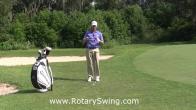
The address position for the Rotary Swing is something that is incredibly simple to do correctly, but its significance can not be overstated. The address position revolves around three key points - athleticism, balance and setup.
Athleticism & Balance
These two key points are inseparable, so I will discuss them as a whole. The golf swing is a very athletic and dynamic movement that requires the body to be balanced and supple.
The address position itself is dynamic and flowing, never rigid. This is how the body maintains balance, with gentle gyrations, subtle corrections, always in motion. To experience this for yourself, try standing on one leg for as long as you can.
At first, become as rigid and perfectly still as you can. As you do, your body will quickly lose balance and you won’t be able to maintain stability. Now try again and allow your body to remain relaxed and move slightly as it constantly works to steady itself.
Your subconscious mind will direct your body to naturally make subtle corrections and maintain balance when your muscles are not rigid and tense. The body is always in motion and maintains its balance best when allowed to remain active rather than being locked into a position.
How many times have you seen a fellow golfer on the range stand frozen over a ball just before hitting a bad shot? It's not pretty and that's now how you want to address the ball.
When addressing the ball, your balance is a key determinant of how well you will strike the ball and if you become rigid at address, you have no chance of making an athletic golf swing anymore than you have a chance of balancing yourself on one leg while remaining stiff.
In any athletic endeavor, the body must remain athletically relaxed, able to respond dynamically to the forces and stresses placed on it. Imagine a basketball player shooting a free throw. This is a perfect analogy for golf because it begins from a stationary address position just as a golf swing does.
Any good free throw shooter has a routine that prepares the body for the shot and this routine is something that keeps the body in constant motion, even if the motion is very subtle. Imagine Michael Jordan preparing to shoot a free throw. He bounces the ball three times with his whole body in motion, spins it in his hands, flexes his knees and fires.
Now compare that to Shaq. Shaq’s preparation to shoot a free throw is equivalent to most amateur golfers addressing a golf shot. They become rigid and tense and look completely unnatural, if not ridiculous.
When addressing the golf ball, “be like Mike”. The athleticism and balance that is so critical to the golf swing is not something that you have to work at. You are already balanced and capable of fluid motion by nature, unless you have trouble walking or standing in general, in which case golf will be difficult for you. Balance and athleticism is a completely innate character of your being and is something that will happen automatically if you let it.
Setup
So that leaves us with the final key component, setup. When I use the term “setup”, I am referring to setting up the body in a particular way with neutral angles that allow the Rotary Swing to happen naturally with no compensations.
The Rotary Swing that I teach is a very natural way to swing the golf club and it starts with a very natural setup of the body. So how do we perform a proper Rotary setup? Like everything else I teach, it’s simple.
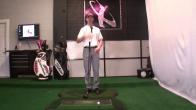
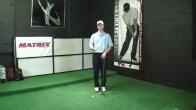
1. Stand straight up in a comfortable and balanced position as if you were talking to someone directly in front of you. Nothing special here, simply have your body centered and balanced over your feet and hips, with your feet spread roughly shoulder width apart.
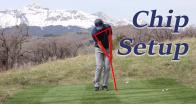
2. While standing in this comfortable, balanced position, flex your knees slightly if they aren’t already and extend both arms out in front of you, bringing your hands together in front of your belt buckle. Now, tilt forward at the hips without tilting your spine to either side, simply tilt straight forward. The spine remains vertical just as it was when you were standing straight up. The back shoulder will be lower than the front only because of the position of the back hand being lower on the club.
Much commotion has been raised in regard to spine angle at address, with some instructors advising tilting “at least” 35 to 45 degrees from vertical. Unless you are very tall I do not advise this, and even then, it is questionable to bend over this much.
If we go back to one of my three key points discussed earlier, balance is listed but a severely bent over spine is not. If you bend over to the point where you feel you are off balance and your weight is out toward your toes - don’t bend over this far!
When determining the proper amount of spine tilt, think balanced and athletic, not how far forward can I bend over and still swing. It is only necessary to bend over slightly more for the Rotary Swing than what you would for a more upright golf swing and is not something that need be exaggerated.
In regards to weight distribution, again, balance is key. However, if you are going to favor any one side, it should be your left, or lead leg. Getting your weight to the left side is a critical component of the Rotary Swing and giving yourself a little head start won’t hurt.
That’s it! If you can stand straight up and not fall over, and then tilt your spine from the hips, I’ll bet you can make a perfect address position for the Rotary Swing.
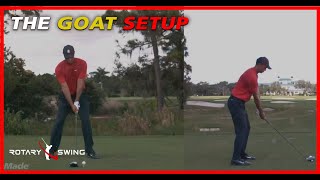
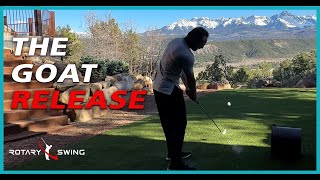
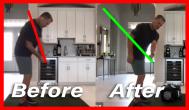
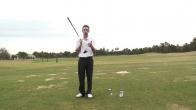
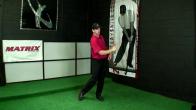
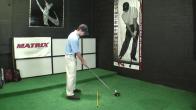
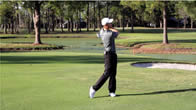
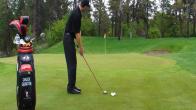
Note the proper posture and setup for the Rotary Swing with the driver from down the line.