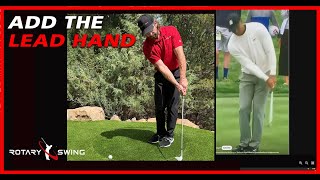
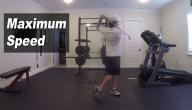
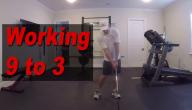
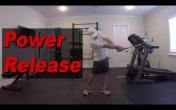
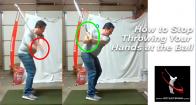
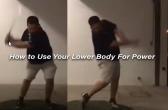
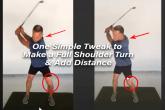
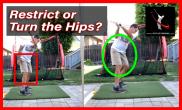
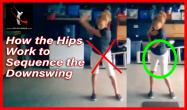
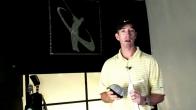
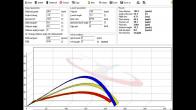
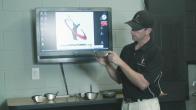
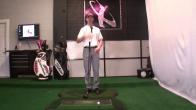
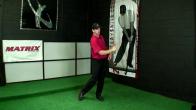
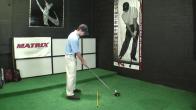
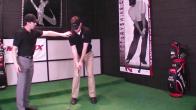
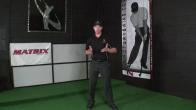
Using our Science and Motion (SAM) Balance Lab, we can pinpoint and weight distribution of golfers in real time. In this video, I use the Balance Lab to demonstrate how simple it is to transfer weight for a potential power increase of around 14 percent according to published research.
The key takeaway is that weight shift is completely natural. In fact, as you will see in the video, to NOT shift your weight will not only feel unnatural but will leave you feeling powerless as well.
Is this the fault costing you strokes?
Film one swing on your phone. In about a minute GOATY measures it and names the single biggest thing costing you strokes — free, no card.
Analyze My Swing Free
Related: Golf swing weight transfer — the AI-coached approach →
Android users: Download GOATY on Google Play — free AI golf coaching on your Android phone. →
Think of any sport involving a hitting or throwing motion — from baseball to tennis — and imagine performing those athletic movements without transferring your weight. The loss of power is immediately obvious.
Stop reading about it — feel it in your swing today
GOATY watches your swing live and coaches you between every rep. Free. No signup.
Start Your FREE Live Lesson →However, in my book, The Rotary Swing, I discuss how it is not necessary for high handicappers or new golfers to focus heavily on weight shift. This is still the case.
If you do not have time to practice nor the desire to work on your golf swing, then simplifying the motion to the fewest moving parts possible is paramount.
But if you are a serious golfer striving to improve, then a proper and efficient weight transfer is absolutely essential for generating maximum power.
Video Transcription: Golf Swing Weight Shift
Golf swing weight shift is one of the most debated topics in golf instruction, especially with golf swing models emerging that advocate staying on the front leg, such as Stack & Tilt.
I also teach golfers who do not have much time to practice, or who are new to golf, not to incorporate significant weight shift during the learning process simply because they do not have enough time to master all the necessary movements.
The golf swing is a complex athletic movement, and we can simplify it dramatically — especially during the learning process — if we minimize as many moving parts as possible.
The trade-off is that there is a measurable loss of power if you do not transfer your weight in the golf swing.

Whole-body weight transfer
You can experience this for yourself.
Go outside and grab a baseball, a rock, or a golf ball on the driving range. Try to throw it as far as you can and notice whether you shift your weight.
I assure you that if you are right-handed, you are going to load back onto your trail heel first, plant your lead heel, and then throw.
Now try throwing that same ball without shifting your weight.
Place all your weight on your back foot and throw without transferring to the front, or place all your weight on the front foot without loading the back foot first, and try to throw it.
Of course, if you do not shift your weight, you lose significant power.
That principle is universal across all sports, whether it is a tennis player striking a ball, a pitcher throwing a baseball, or a batter driving through the hitting zone.
Athletes load up on the trail side, then step through onto the lead side for the delivery. Weight shift is simply a fundamental component of athletic power generation.
In golf, it is no different.
The problem historically is that golf swing weight shift has been taught by taking the upper body and swaying it off the ball to the trail side, then swaying back to the lead side.
It was all upper-body movement — the entire torso moving back and forth.
It has also been taught to take the entire body and shift the whole thing a couple inches to the trail side, then attempt to shift everything back to the lead side.
It is extremely difficult to time that movement correctly, but it does effectively transfer weight — the shift to the trail side is real.
I am actually standing on our SAM Balance Lab right now.

Upper body sway
If I bring up the screen, you will see that as I perform my upper-body sway, my weight shifts well to the trail side. I am at 90 percent, and then I sway back to the lead side, and now I am at 95 percent on the lead. I did effectively shift weight.
Of course, the fulcrum of my golf swing is moving all over the place.
Now, as I am moving back and forth this way, it is going to be extremely difficult to make consistent contact.
Because of that, several golf swing models have emerged that said, "Well, let us just not move at all. Let us stay on the lead side and not shift our weight. Let us just stay here and hit down."
That is the equivalent of trying to throw a baseball while standing on your lead foot without any loading movement.
It is effective for hitting down on irons — you can cheat a little because your will be steeper.
You can de-loft the club more. You can still achieve reasonable distance with the irons. The ball flight will be slightly lower, and it will work.
Of course, as you progress to the longer clubs, you are not going to catch the driver on the upswing, you are not going to achieve adequate launch height, because it is very difficult to stay on the lead side and then get back behind the ball through impact. So this approach is not effective for the longer clubs.
For shorter irons, it is perfectly fine, and I still advocate minimizing weight shift on shorter iron shots because you want to flight them lower.
You do not want your wedge launching straight up in the air. You want to hit down, compress the wedge shot, and hit it low with penetrating trajectory.
Minimizing golf swing weight shift for those shots is completely acceptable.
If you do not have much time to practice and you spend very little time working on your golf swing, you do not want a lot of weight shift.
But if you are building power into your golf swing and you do have time to practice golf, you are serious about your game — you will see how simple it is to learn how to transfer your weight effectively. To see how your weight shift and swing mechanics measure up against elite standards, try a free AI swing analysis.

Weight is balanced
I will show you what that looks like. Standing on the Balance Lab, right now my weight is approximately 50/50.
All I am going to do to shift my weight is move just a little bit to the trail side.
You will see right now I am at 50 percent, and I am going to shift just slightly with my hips. Now I am at about 62 percent.
I am loading up into my trail side here to access power from the trail side of my body — my glutes, my hamstrings, my back.
I want to load those muscles, so I am essentially shifting my hips just slightly to the trail side.
I do not have to shift my entire body. It is a very simple movement. There I am, holding at about 65 percent. I have made just a small amount of movement.
Now, as I go into my full swing and my arms and everything else get moved behind me, by the time I reach the top I am going to be at approximately 75 to 80 percent on my trail side.
Research on golf swing weight shift has demonstrated that most Tour professionals are at about 75 to 80 percent on their trail side at the top of the backswing, before they begin transitioning back to the lead side.
Their maximum weight shift is approximately 75 to 80 percent on the trail side, and that is what we generally target — from 50/50 to approximately 75-80 percent at the top. Right now I am at 75 percent.

Maximum golf swing weight shift
It requires very little movement. Your head may move slightly, and that is perfectly acceptable. You are going to get back to the lead side on the downswing.
All that movement consists of is not rotating — simply shifting weight back to the trail side. That is it.
I can shift this way, I can shift that way. It is a very simple little movement — shifting to the inside of my foot just to load up.
Exactly the same as if I were a baseball hitter loading up into the trail leg for a moment before the swing. Load into that trail side, just for a split second.
I might be standing here and then load and spring back. We want that type of dynamic movement. It is not that you shift and just sit there.
The purpose is loading and stretching these muscles. That is where you generate power — by stretching muscles, because they then want to release and fire back.
As I settle into that trail side, my glutes are contracting and stretching, so now I have loaded force into that side.
That is what you want to feel as you go back — that you are loading into that trail side just a little bit.
The critical distinction is not doing it with your upper body. Many golfers will say, "OK, I just shifted my hips," but then their entire head moves with them.
It is not that much movement. It is very simple — you can see that I can still shift my weight, but if I also move my entire upper body, I am going to have to sway back to reach the ball. Obviously, we do not want that.
Again, it is just a tiny little bump. That is it.
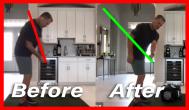
The problem arises when your stance is too wide.
Now you will see that in order to achieve the same weight distribution — to load up into that trail side and stretch all the muscles effectively — I need to move much further. The trail glute is going to act as a stabilizer going back and loading into it.
In order to effectively transfer my weight from address with a wide stance, I have to shift significantly. Now I am only at 65 percent, but my head has already moved a couple of inches.
As I continue to 75-80 percent, my head has moved a great deal, so now it has to travel all the way back through impact.

Stance is too wide
From here, if I simply bring my foot back to a normal width, I do not have to move nearly as far to get that weight back over to the lead side.
That is precisely why stance width is so important. You can go a little wider than your hips, and that is what truly matters.
You can use your hip bones as a measurement — your feet should be positioned approximately a couple inches wider than your hips, but that is about the maximum stance width for you, based on your hip width.

Correct stance width is just outside neutral, roughly 2 inches
It has absolutely nothing to do with your shoulders. It has everything to do with your hips.
If I set up at the correct width, it becomes very easy to shift my weight back and forth without making a large, uncontrolled movement off the ball.
If you want extra power in your golf swing, you need to shift your weight.
Research on golf swing weight shift has shown that golfers who do not shift their weight experience approximately a 14 percent loss in energy transfer.
Fourteen percent for someone hitting the ball 200 yards can translate to 30 yards of lost distance.
You could be leaving 30 yards on the table simply by not being able to load into the trail side and then fire back, effectively stretching the lead side muscles.
Weight shift is a positive, essential component of the golf swing. It is not a big sway. It absolutely does not come from the upper body. It originates from the hips, and it is a remarkably simple movement to master. For real-time feedback on your weight transfer and power mechanics, try a free AI golf lesson.
Watch part 2 now to see how you're moving your body in the opposite direction of the pros!