Let's examine the putting grip — one of the most overlooked fundamentals in golf. The correct grip accomplishes two critical things:
- It minimizes wrist hinge and hand manipulation during the putting stroke, creating a more repeatable motion.
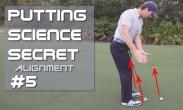
- It aligns your body correctly. With a proper grip, your forearms run parallel to your hips, shoulders, and feet — dramatically improving the consistency of your stroke path.
Let's break it down step by step.
Is this the fault costing you strokes?
Film one swing on your phone. In about a minute GOATY measures it and names the single biggest thing costing you strokes — free, no card.
Analyze My Swing Free
Related: Golf posture — how AI tracks setup through impact →
Android users: Download GOATY on Google Play — free AI golf coaching on your Android phone. →

The full swing grip runs through the fingers
The defining feature of the putting grip is that the shaft runs through the palms of your hands rather than down in the fingers.
Stop reading about it — feel it in your swing today
GOATY watches your swing live and coaches you between every rep. Free. No signup.
Start Your FREE Live Lesson →With a normal full swing grip, the club sits across the fingers of both hands. Gripping through the fingers enables significant wrist hinge during the swing, generating the speed and power you need for distance.
In putting, power and speed are the last things you want. So we grip the putter in an entirely different way — one that promotes stability and feel over force.
Start With the Lead Hand

The finger tips press the grip against the hand
Look at the palm of your lead hand and find the "life line" crease that starts at the front of your wrist, between the two pads on the heel of your hand.
This is where you want the corner of the grip to sit — and you'll use this same reference point on both hands.
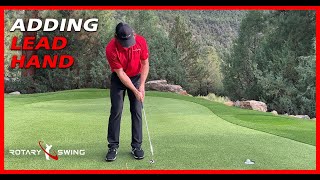
Let's start with the lead hand.
Place your lead hand on the grip so the life line sits directly on the corner of the grip, then close your fingers. You'll notice that you're pressing the grip against the palm with just your fingertips.

There may be a small gap between fingers & grip
Your fingertips should feel like they're pushing the club into the palm of your hand.
There may be a slight gap between your fingers and the bottom of the grip. If you use a thicker grip, the gap may close completely — either way, it makes no difference to the mechanics.
You don't need a firm finger grip because you're not generating power. Putting is about consistency and feel, not force.

Thumb at an angle
The life line should align directly on the corner of the putting grip, with the fingertips pressing the shaft into the palm.
As you place your thumb on the grip, notice that it sits at a slight angle rather than running straight down the top. That's exactly right. To get the thumb perfectly straight down the shaft, you'd need to shift the club deeper into your fingers — which defeats the entire purpose of the palm grip.
Keep the club out of the fingers and centered in the palm.
The club should form a continuous line with your forearm. If you slid the putter up through your lead hand, the shaft would run directly along your forearm.

One consistent line
Viewed from down the line, your lead hand grip should create one single, unbroken line from the elbow pit all the way down to the club head.
Maintaining that straight line is one of the biggest keys to a repeatable, consistent putting stroke.
Now Add the Trail Hand
When you add the trail hand onto the grip, you're going to follow the exact same placement as the lead hand. Line up the life line of your trail hand with the corner of the grip on the opposite side.
The easiest way to do this is to temporarily lift your lead index finger off the grip.

End of life line (above) on knuckle (below)
Find the bottom of the life line on your trail hand — between the two pads on the heel — and place that spot on the last knuckle of the middle finger of your lead hand, as shown in the photo.
Once you fit your hands together this way, allow the remaining fingers of your trail hand to grip the club underneath the lead index finger.
Allowing the lead index finger to overlap the fingers of the trail hand is called a reverse overlap grip. This grip style provides additional consistency by keeping the hands working as a single unit.
You can use either the reverse overlap or a standard grip — it's purely a matter of personal feel and preference.
If you set up the grip with both hands and then remove the lead hand, you'll see that the trail hand position mirrors the lead hand exactly.
Your fingertips push the club into the palm, the corner of the grip runs up the life line, and the grip is centered between the pads on the heel of the hand.

Right hand position
Once again, sliding the putter up through your trail hand reveals that the shaft runs directly along your forearm.
Both Hands Together
When you bring both hands together on the putter, you'll notice that the trail thumb sits at a slight angle — just like the lead thumb.
That's perfectly fine because, again, forcing the thumb straight down the shaft would require gripping the club deeper in the fingers — introducing unwanted wrist hinge.
Just as with the lead hand, when you take your address posture you should be able to draw one straight line from the tip of the elbow all the way down to the club head on both sides.

Face on view
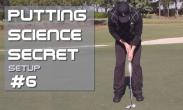
If you rested a club across both forearms, it would sit parallel to your feet, hips, and shoulders.
Everything is aligned consistently at address. As you stroke back and through, everything naturally wants to work along the same line.
Pay particular attention to your putting grip. Confirm that your hands and forearms are aligned correctly, and you'll see a noticeable increase in stroke consistency. For the same kind of technical precision in your full swing, try a free AI swing analysis that breaks down your mechanics instantly. To practice with real-time coaching feedback, check out a free AI golf lesson.
Watch part 2 now to see how you're moving your body in the opposite direction of the pros!