Much has been written on the importance of a good golf swing grip over the years, Ben Hogan devoted 17 pages to it in his book "Five Fundamentals", making it seem to many that it is some magical, mystical secret of the golf swing. But over the years teaching countless golfers I've learned a couple things.
One, grips come in all shapes and sizes and can still be effective. And two, there is an ideal way to grip the golf club based on mechanics and human anatomy and it is very easy to learn. In this video I show you the details of how to grip the golf club that allows the hands to seemlessly work together as a unit, regardless of your golf swing type.
From there, you can adjust for your golf grip to what works best for your swing and desired ball flight.
How to Grip the Golf Club
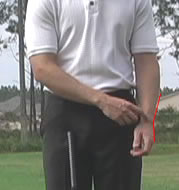
To start learning a proper golf grip, stand with your hands down at your side and note how when completely relaxed, your hands will have a slight cupping at the wrist joing. This is a natural position for the wrist to sit in and is something that should be maintained throughout the process of learning how to take your grip.
Next, notice how when you bring your arm across your body, how it rotates slightly creating the appearance that this cupping increases, although it doesn't change much.
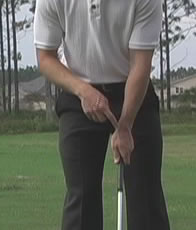
As you bring your right hand in from underneath and across your body, the left thumb will sit in the lifeline of the right hand. You should feel very snug and secure and be able to hold a tee between the thumb and forefinger of each hand without being tense.
Where Should the "V's" Point?
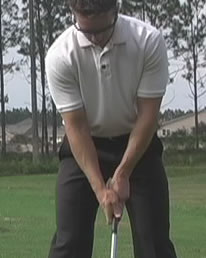
You want the "V's" formed by the thumb and forefinger on each hand to point toward your right ear and shoulder. If they point more to the left, that is considered a weaker grip and will tend to require the golfer rotate the forearms more aggressively through impact to square the clubface.
A grip that points more toward the right shoulder will be considered a stronger grip and can result in hooking problems when coupled with a golfer who likes to aggressively release the the hands and clubface through impact. Start neutral and go from there.
The most important thing about your grip is that it should feel like a day of perfect weather - you simply don't notice it. If you find yourself fiddling with your grip or feeling uncomfortable, keep a club around you and grip it atleast 20 times a day for a couple weeks to adjust to your new golf swing grip.
{josociallocker}
The Grip Video Transcription
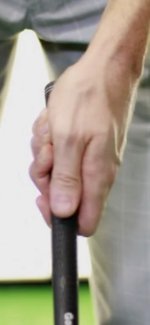
Weak to neutral grip
The grip is one of the most important and overlooked fundamentals of the golf swing. In this video I'm going to walk through, step by step, how to take a proper grip, going first with the left hand and then with the right hand.
I'm also going to talk about how having your grip differently than what I describe is going to affect your swing and the ball flight; not necessarily wrong or right, but I'm going to show you what type of tendencies you're going to develop.
Let's first start with the left hand - getting the left hand on the grip properly. I'm going to talk about the muscles that you're going to use, how the club needs to line up, and what issues you're going to run into. Let's take a close look at the left hand.
When looking at the left hand, the most common mistake that I see is with golfers who take the grip in a very weak position. When we say "weak," what we're really looking at, you'll hear terms defined either by the line formed by the thumb and forefinger - this little "V" as it's commonly referred to - what direction that points, or how many knuckles on the left hand you can see.
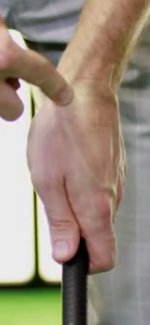
Strong grip
You can see here, if I take this line and I have it pointing up more towards the center of my body and you can only see maybe one knuckle there, that's considered a weak or maybe neutral grip, depending on who defines it.
More or less, this is going to be a very common grip that's going to make it very difficult for you to square the club face, coming up into impact. You'll see that I can see a lot of the butt of the club here. You never want to be able to see the butt of the club, looking face on. It should be covered up by the meaty pad of your left hand.
Let's look at what that's going to look like, first. We're going to define strong and weak here. This would be a very strong grip. Notice that this part of the grip is now missing; you can't see it from face on, and there's a little crease right here you can see between these two tendons, you can put your finger in. That's now set up to the right of the center of the shaft.
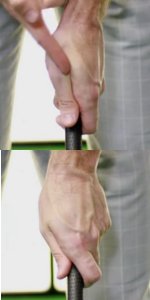
The V points to the right ear (above) and beyond the right shoulder (below)
This is weak, this little gap here set to the left. In an ideal world, you're going to set that pretty much over the center or just to the right of center of the shaft. That's a good way of checking it. Notice that from your perspective, you really shouldn't be able to see much of the butt of the club here.
Here you can see a lot, here you can't see any at all. This would be a very strong grip. There's pluses and minuses for that, that I'm going to go over in a minute.
For right now, in an ideal world, we want to be just slightly stronger than neutral. In other words, a good way of looking at it is taking this V and getting it to point about to your right ear, assuming you're a right-handed golfer. This is pointing up towards my right ear.
This would be pointing well beyond my right shoulder. You can see I can see a lot of knuckle, maybe all four knuckles here.
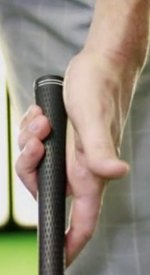
Grip strength comes from the last three fingers
About two and a half knuckles is a good generic gauge there. The big thing, the definition of where you want to be, in terms of strength, is how you grip the club. This is a big deal.
If I were to show you how you should properly grip the club, you could do it more or less with your thumb and forefinger off the club. In other words, the majority of your gripping strength is coming from these fingers, which is going to activate the flexor muscles in your forearm. That's where the majority of your grip strength comes from.
You should be able to hold the club pretty securely with just these three fingers. If you're using these a lot and you see a big wear spot in the thumb part, where your thumb sits on the shaft, you're running into all kinds of issues.
Typically you'll get this wear pattern at impact and during the transition if you're using your thumb too much, and you're going to hurt the tendon in your thumb. Your thumb should be pretty relaxed on the club. Most of your grip strength is going to come from here.
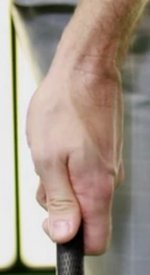
Thumb & forefinger pinch together
You don't need to hold the club tightly at all. If you used a scale of 1-10, you could say a 2-4 at the high end, and that these two fingers are going to be pinched together to keep the club from slipping at the top of your swing.
If your thumb and forefinger are gapped like this, the club as you get to the top of your backswing can start to "fall" out. When people complain about having to re-grip the club, 9 times out of 10 it's because they don't have this thumb and forefinger together.
With my thumb and forefinger together, as you can see here, as I get to the top of the swing the thumb can support the shaft without me having to grip it really tight with my fingers.
Get this pad over the top of the shaft, the center of the shaft. That will line up this little gap pretty close to the center of the shaft. It's going to give you a lot of leverage on the club. You should notice, again, about 2-2.5 knuckles, and there should be a little natural cupping in your left wrist. Thumb and forefinger pinched together. Your thumb and forefinger are light on the club. The majority of your gripping strength is coming from here.
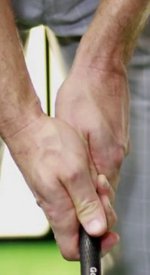
Match the right hand up with the left
In a minute I'll go through what "strong" versus "weak" is going to do for your hand, but for now those are the main things you need to know.
Now with the right hand, as we bring it in, we just want to match it up with the left. In other words, the thumb and forefinger on this hand are now going to be parallel to the thumb and forefinger on that hand.
You'll see that this line is going to run basically right up through the center of my forearm, and right up to my right shoulder. Because it's parallel, it's going to be to the right of the thumb and forefinger line which is going up towards my right ear with the left hand. This one's going to go a little bit farther right because they're parallel to each other.
Adding the right hand
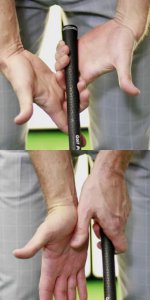
The other thing is that I want to grip it a little bit more in the fingers. You're going to have a little bit more palm on the grip here. The right hand's going to sit a little bit more in the fingers. If you look closely here, you can see how it sits right through this little crease in my first knuckle. It sits just like that.
I'll move the left hand out of the way. There. Again, thumb and forefinger are light on the club. My left thumb is going to sit nicely in the lifeline of my right hand. You can see how they mesh up there really nice.
As I bring that on, that's going to go right like that. The knuckle of my left thumb is sitting up in my lifeline on my right hand. This hand just comes across, and that's that.
Again, thumb and forefinger need to be pinched together because if you go to the top of the swing and you hold the club like this, the club's going to go right through your hands. You're going to have zero control over that club face. It's really important that these two guys are pinched together.
Separation of the "trigger" finger
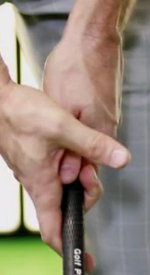
Whether or not there's separation here, which is something you see a lot - a lot of golfers call their right forefinger the "trigger finger" and want to push against the shaft there - you really don't need to do that. In fact, that's going to cause you a lot of problems. It's going to make it really easy for the average amateur to flip the club, if you're pushing against it with this forefinger.
Whether or not you have it separated is not a big deal. What's more important is that you grip the club primarily in the middle two fingers of your right hand and the last three fingers of your left hand, and avoid gripping it tightly with the thumb and forefinger here on your right hand.
That's it. That's all it takes to get a proper grip. Now we can run into a million problems if we don't have this type of grip. I'm going to give you a couple of things, what I see most commonly, and talk about the pros and cons of each.
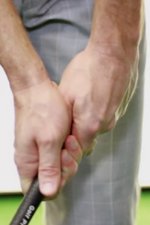
Hands ahead of the ball at impact
One is having a really strong grip. I go back to this left hand, and the right hand is really strong as well. What this is going to do is make it so that you could, if you wanted to, have your hands way ahead of the ball at impact, and still have the club face square. What this is going to do is de-loft the heck out of the golf club and you're going to hit the ball very, very low.
At the same point, it's not necessarily a bad thing if you want to do that, but if you don't have a lot of shaft lean at impact and you're the type of golfer who loses a lot of lag, and you have a really strong grip, you're going to tend to hit the ball really hard to the left, so again, more of a neutral or slightly stronger than neutral grip is what we're looking for.
The opposite, let's go with a really weak grip. Now you can see the thumb and my forefinger on my right hand are pointing over to the left side of my head. Now I'm going to require a lot of hand manipulation, coming into the ball, in order to square the club face; not ideal, again.
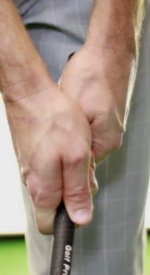
A few degrees of shaft lean
Again, slightly stronger than neutral is ideal. It allows you to get a little bit of shaft lean, all you need. Just a few degrees of shaft lean here. Again, that's a variable. You can have four or five, up to eight degrees of shaft lean, depending on the trajectory you're looking for, and still have the club face square without having to manipulate it with your hands.
If you go stronger than that, you can get your hands much farther ahead and still have the club face square. If you go weaker, your hands are going to tend to be a little bit more in line with the ball, because if you get your hands way ahead of the ball the club face is going to be wide open.
Again, just go through the simple sequence of getting your grip proper on the club and you won't have anything to worry about. Changing your grip, just keep a club handy for a couple of weeks. It won't take long, and just keep re-gripping it until you get comfortable with this.
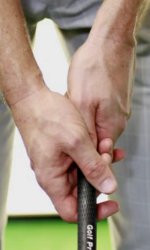
Hands are not equal on the club
Then the big thing is, just make sure that both hands are on the club equally. A lot of times I see that golfers who come to lessons have their left hand on the club pretty tight, and the left hand looks like this. I know they're not going to be able to do anything with the right side of their body if the right hand is not on the club.
Using the right hand, the Throw the Ball Drill and all those things, is completely taken out of the equation if I see your grip like this; the left hand is cinched down and I see your knuckles starting to turn white.
Make sure that both hands are on there securely. You need to use both in the golf swing. Work through this grip sequence, and you'll be able to start hitting the ball much more consistently with a lot less effort, trying to manipulate the club face with your hands.
Checkpoints for Practice
In a "strong" grip, the V of the left thumb points beyond the right shoulder - a "weak" grip points to the center of the body
Neutral to slightly strong is the preferred grip for most golfers
The pad of the left hand & space between the tendons at the base of the left thumb should both be about at the center of the shaft
Most of the force is exerted with the back three fingers - thumb and forefinger are light on the club, but pinch together to prevent the shaft slipping through at the top
The right hand matches up to the left - the V of the right thumb parallels the V of the left
The left thumb nestles into the lifeline on the right hand
The hands should grip the club securely - don't let the left do all the work
The grip is one of the most important and overlooked fundamentals of the golf swing. In this video I'm going to walk through, step by step, how to take a proper grip, going first with the left hand and then with the right hand.
I'm also going to talk about how having your grip differently than what I describe is going to affect your swing and the ball flight; not necessarily wrong or right, but I'm going to show you what type of tendencies you're going to develop.
Let's first start with the left hand - getting the left hand on the grip properly. I'm going to talk about the muscles that you're going to use, how the club needs to line up, and what issues you're going to run into. Let's take a close look at the left hand.
When looking at the left hand, the most common mistake that I see is with golfers who take the grip in a very weak position. When we say "weak," what we're really looking at, you'll hear terms defined either by the line formed by the thumb and forefinger - this little "V" as it's commonly referred to - what direction that points, or how many knuckles on the left hand you can see.
Strong grip
You can see here, if I take this line and I have it pointing up more towards the center of my body and you can only see maybe one knuckle there, that's considered a weak or maybe neutral grip, depending on who defines it.
More or less, this is going to be a very common grip that's going to make it very difficult for you to square the club face, coming up into impact. You'll see that I can see a lot of the butt of the club here. You never want to be able to see the butt of the club, looking face on. It should be covered up by the meaty pad of your left hand.
Let's look at what that's going to look like, first. We're going to define strong and weak here. This would be a very strong grip. Notice that this part of the grip is now missing; you can't see it from face on, and there's a little crease right here you can see between these two tendons, you can put your finger in. That's now set up to the right of the center of the shaft.
The V points to the right ear (above) and beyond the right shoulder (below)
This is weak, this little gap here set to the left. In an ideal world, you're going to set that pretty much over the center or just to the right of center of the shaft. That's a good way of checking it. Notice that from your perspective, you really shouldn't be able to see much of the butt of the club here.
Here you can see a lot, here you can't see any at all. This would be a very strong grip. There's pluses and minuses for that, that I'm going to go over in a minute.
For right now, in an ideal world, we want to be just slightly stronger than neutral. In other words, a good way of looking at it is taking this V and getting it to point about to your right ear, assuming you're a right-handed golfer. This is pointing up towards my right ear.
This would be pointing well beyond my right shoulder. You can see I can see a lot of knuckle, maybe all four knuckles here.
Grip strength comes from the last three fingers
About two and a half knuckles is a good generic gauge there. The big thing, the definition of where you want to be, in terms of strength, is how you grip the club. This is a big deal.
If I were to show you how you should properly grip the club, you could do it more or less with your thumb and forefinger off the club. In other words, the majority of your gripping strength is coming from these fingers, which is going to activate the flexor muscles in your forearm. That's where the majority of your grip strength comes from.
You should be able to hold the club pretty securely with just these three fingers. If you're using these a lot and you see a big wear spot in the thumb part, where your thumb sits on the shaft, you're running into all kinds of issues.
Typically you'll get this wear pattern at impact and during the transition if you're using your thumb too much, and you're going to hurt the tendon in your thumb. Your thumb should be pretty relaxed on the club. Most of your grip strength is going to come from here.
Thumb & forefinger pinch together
You don't need to hold the club tightly at all. If you used a scale of 1-10, you could say a 2-4 at the high end, and that these two fingers are going to be pinched together to keep the club from slipping at the top of your swing.
If your thumb and forefinger are gapped like this, the club as you get to the top of your backswing can start to "fall" out. When people complain about having to re-grip the club, 9 times out of 10 it's because they don't have this thumb and forefinger together.
With my thumb and forefinger together, as you can see here, as I get to the top of the swing the thumb can support the shaft without me having to grip it really tight with my fingers.
Get this pad over the top of the shaft, the center of the shaft. That will line up this little gap pretty close to the center of the shaft. It's going to give you a lot of leverage on the club. You should notice, again, about 2-2.5 knuckles, and there should be a little natural cupping in your left wrist. Thumb and forefinger pinched together. Your thumb and forefinger are light on the club. The majority of your gripping strength is coming from here.
Match the right hand up with the left
In a minute I'll go through what "strong" versus "weak" is going to do for your hand, but for now those are the main things you need to know.
Now with the right hand, as we bring it in, we just want to match it up with the left. In other words, the thumb and forefinger on this hand are now going to be parallel to the thumb and forefinger on that hand.
You'll see that this line is going to run basically right up through the center of my forearm, and right up to my right shoulder. Because it's parallel, it's going to be to the right of the thumb and forefinger line which is going up towards my right ear with the left hand. This one's going to go a little bit farther right because they're parallel to each other.
Adding the right hand
The other thing is that I want to grip it a little bit more in the fingers. You're going to have a little bit more palm on the grip here. The right hand's going to sit a little bit more in the fingers. If you look closely here, you can see how it sits right through this little crease in my first knuckle. It sits just like that.
I'll move the left hand out of the way. There. Again, thumb and forefinger are light on the club. My left thumb is going to sit nicely in the lifeline of my right hand. You can see how they mesh up there really nice.
As I bring that on, that's going to go right like that. The knuckle of my left thumb is sitting up in my lifeline on my right hand. This hand just comes across, and that's that.
Again, thumb and forefinger need to be pinched together because if you go to the top of the swing and you hold the club like this, the club's going to go right through your hands. You're going to have zero control over that club face. It's really important that these two guys are pinched together.
Separation of the "trigger" finger
Whether or not there's separation here, which is something you see a lot - a lot of golfers call their right forefinger the "trigger finger" and want to push against the shaft there - you really don't need to do that. In fact, that's going to cause you a lot of problems. It's going to make it really easy for the average amateur to flip the club, if you're pushing against it with this forefinger.
Whether or not you have it separated is not a big deal. What's more important is that you grip the club primarily in the middle two fingers of your right hand and the last three fingers of your left hand, and avoid gripping it tightly with the thumb and forefinger here on your right hand.
That's it. That's all it takes to get a proper grip. Now we can run into a million problems if we don't have this type of grip. I'm going to give you a couple of things, what I see most commonly, and talk about the pros and cons of each.
Hands ahead of the ball at impact
One is having a really strong grip. I go back to this left hand, and the right hand is really strong as well. What this is going to do is make it so that you could, if you wanted to, have your hands way ahead of the ball at impact, and still have the club face square. What this is going to do is de-loft the heck out of the golf club and you're going to hit the ball very, very low.
At the same point, it's not necessarily a bad thing if you want to do that, but if you don't have a lot of shaft lean at impact and you're the type of golfer who loses a lot of lag, and you have a really strong grip, you're going to tend to hit the ball really hard to the left, so again, more of a neutral or slightly stronger than neutral grip is what we're looking for.
The opposite, let's go with a really weak grip. Now you can see the thumb and my forefinger on my right hand are pointing over to the left side of my head. Now I'm going to require a lot of hand manipulation, coming into the ball, in order to square the club face; not ideal, again.
A few degrees of shaft lean
Again, slightly stronger than neutral is ideal. It allows you to get a little bit of shaft lean, all you need. Just a few degrees of shaft lean here. Again, that's a variable. You can have four or five, up to eight degrees of shaft lean, depending on the trajectory you're looking for, and still have the club face square without having to manipulate it with your hands.
If you go stronger than that, you can get your hands much farther ahead and still have the club face square. If you go weaker, your hands are going to tend to be a little bit more in line with the ball, because if you get your hands way ahead of the ball the club face is going to be wide open.
Again, just go through the simple sequence of getting your grip proper on the club and you won't have anything to worry about. Changing your grip, just keep a club handy for a couple of weeks. It won't take long, and just keep re-gripping it until you get comfortable with this.
Hands are not equal on the club
Then the big thing is, just make sure that both hands are on the club equally. A lot of times I see that golfers who come to lessons have their left hand on the club pretty tight, and the left hand looks like this. I know they're not going to be able to do anything with the right side of their body if the right hand is not on the club.
Using the right hand, the Throw the Ball Drill and all those things, is completely taken out of the equation if I see your grip like this; the left hand is cinched down and I see your knuckles starting to turn white.
Make sure that both hands are on there securely. You need to use both in the golf swing. Work through this grip sequence, and you'll be able to start hitting the ball much more consistently with a lot less effort, trying to manipulate the club face with your hands.
{/josociallocker}
Learn the 3 Tour Pro Consistency Secrets You've NEVER Heard!
Watch part 2 now to see how you're moving your body in the opposite direction of the pros!
We're after one thing: Real Results - Real Fast.
And that's exactly what our members achieve.
And that's why they say the AXIOM is:
Mind-blowing. Game changing. Revolutionary.
RotarySwing was founded out of frustration with the current state of golf instruction. Quinton knew a better way had to exist to learn this game we all love.
The GOAT Code is finally ready after 3 decades of exhaustive work -
you can now learn how to play the game like Tiger and have incredible
control over the ball. This NEW program is truly a step-by-step process
that takes you from green to tee and will teach you the secrets of how
to play like the Greatest Of All Time. If you would like to switch over
to the new GOAT Code program, simply click the green button below.
Don't worry, you can easily switch back at any time and will see a new
button at the top of your screen to switch back whenever you like.
What are the main advantages of the new program?
It cuts down on the clutter - the videos you will see are all
you need to play your best golf ever - nothing more, nothing less
It is truly step-by-step - no more wondering what you should be
working on, the program guides you through every step of the way
Faster progress - you will see improvements in your scores incredibly
fast and this will immediately begin to spill over into your full swing,
even while working on just your putting!
There's a reason that Earl Woods taught Tiger how to play the game
from the green back.
I admit, at first, even I didn't think it was necessary. I thought I
could skip ahead and learn the full swing without building a solid
foundation in putting, chipping and pitching.
All this belief did was cost me MORE time than had I started
at the beginning just like The GOAT did. Over the past 20 years of
doing golf clinics, my observations of thousands of students was
always the same - those who started the slowest at the beginning
always got there the fasted in the end.
In other words, the students I observed being diligent with the
small things like grip, setup, posture and the basics of controlling
the clubface on day 1 were always WAY further ahead of those who
didn't on day 1.
In the post above by member Everett, he said it all in a nutshell.
Go through the program exactly the way it is laid out and you
will have extraordinary results. Skip to the end and you'll end up
with the exact same swing you started with.
This is a system, not a grouping of random tips.
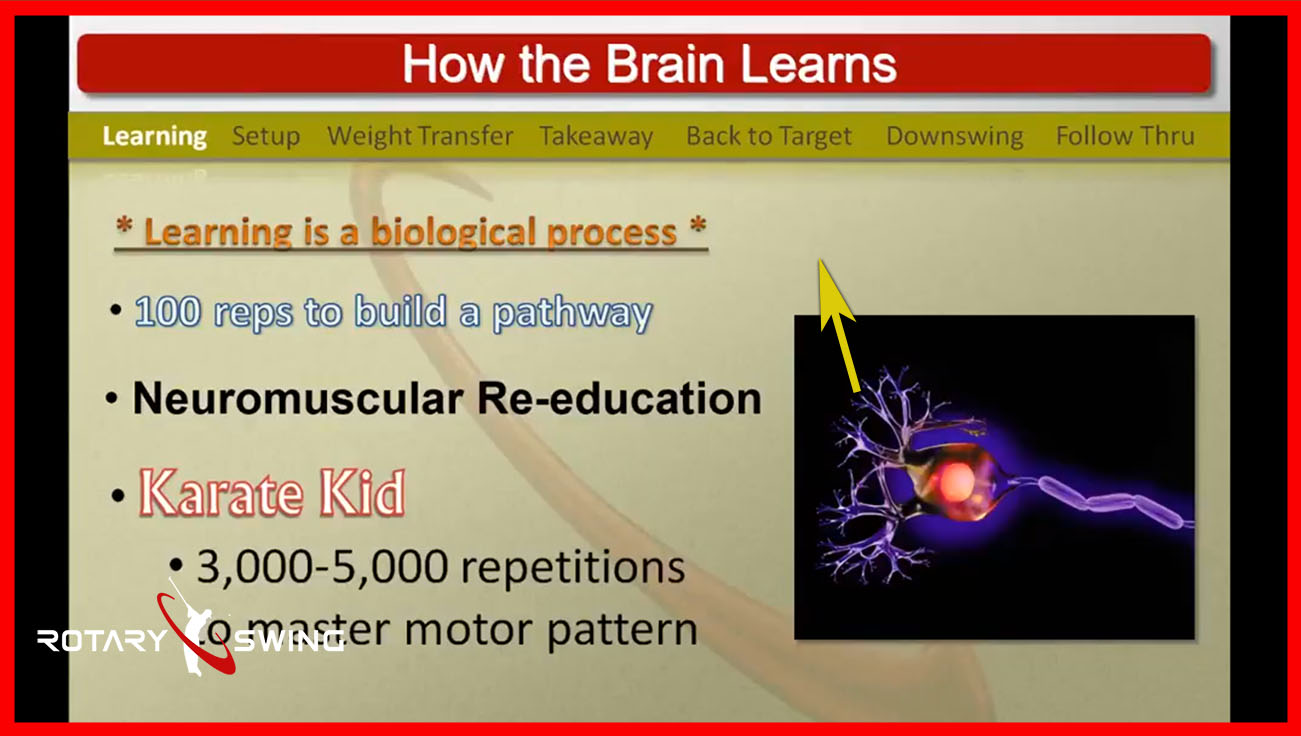
There is a method to my madness deeply rooted in learning psychology
and over 30 years of teaching hundreds of thousands of golfers
just like you how to hit a ball with a stick. Slow down and you'll
get there faster...







































































































 Weak to neutral grip
 Strong grip
 The V points to the right ear (above) and beyond the right shoulder (below)
 Grip strength comes from the last three fingers
 Thumb & forefinger pinch together
 Match the right hand up with the left
 Adding the right hand
 Separation of the "trigger" finger
 Hands ahead of the ball at impact
 A few degrees of shaft lean
 Hands are not equal on the club
 Weak to neutral grip
 Strong grip
 The V points to the right ear (above) and beyond the right shoulder (below)
 Grip strength comes from the last three fingers
 Thumb & forefinger pinch together
 Match the right hand up with the left
 Adding the right hand
 Separation of the "trigger" finger
 Hands ahead of the ball at impact
 A few degrees of shaft lean
 Hands are not equal on the club