










Boost Stability and Power with the Anchor
Learn the 3 Tour Pro Consistency Secrets You've NEVER Heard!
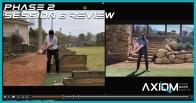
Watch part 2 now to see how you're moving your body in the opposite direction of the pros!
Published: February 17, 2014
An all too common swing fault for millions of golfers is to come out of their posture, or lose their spine angle, during the downswing. This "early extension" is something that not only robs the golfer of control and power, but places the golfer at potential risk for injury in the lead hip and lumber spine (low back).
Unfortunately, most golfers and even instructors don't understand the biomechanical causes of this common fault, or how to fix it. To first understand how to fix it, let's first look at what it looks like when done correctly from a unique angle.
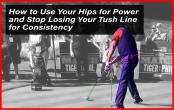
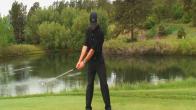
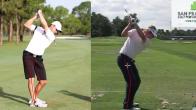
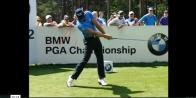
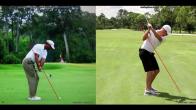
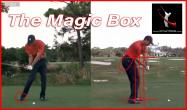
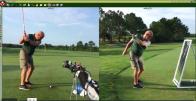
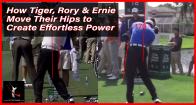
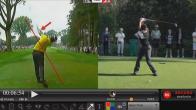
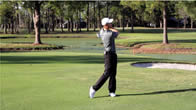
In the photo sequence below is footage of Tiger Woods hitting a three wood. The image on the left is Tiger after he has already started the club back down during the downswing. Of imporant note here is that BOTH knees are still flexed significantly.
In the second photo we can see that Tiger's belt has moved up significantly above where it was during the transition (indicated by the yellow line), almost in a jumping fashion, all the while, maintaining the flex in his right knee.

For most amateurs, they never load their gluteus (butt) muscles during the downswing as Tiger has by "squatting" during the transition, which is a tremendous source of power and stability. In fact, many golfer straighten the right leg completely before they finish their backswing.
If they do maintain the proper knee flex they start pushing off their right foot in the downswing to spin their hips around as fast as possible, leaving the club and arms stuck behind the body and causing them to lose their spine angle.
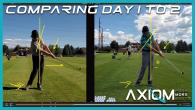
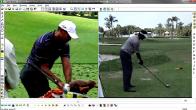
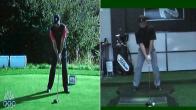
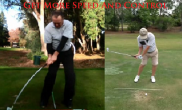
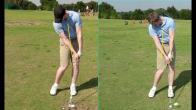
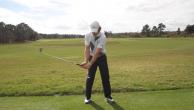
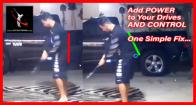
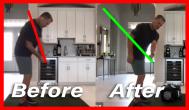
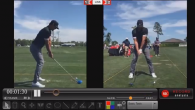
Let's take a closer look at what happened during the first image with Woods above from the down the line view. Below, you can see that both Tiger on the right and me on the left have the look of "squatting" during the transition and have maintained or slightly increased our knee flex that we had a the top of the swing.
From a biomechanics standpoint this is critical to be able to load the gluteus muscle for power and stability. If you straighten up during this phase, it causes an "over the top" move so common to amateurs and saps all the power from the powerful trunk muscles.

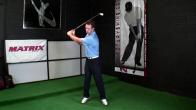
If we look at the top of the swing positions below, we can see that there is about 162 degrees of knee flex at the top of the backswing. Maintaining this knee flex is the most powerful way that you can activate the right glute at this point in the swing to be able to use the ground for leverage during the downswing, or create Vertical Ground Force (VGF).

As we start down, this flex in the right knee is maintained or slightly increased. (Note that it appears to increase more than it actually does do to the fact that the rear leg externally rotates somewhat during the backswing.) This is where the dynamic loading of the glutes is really set into motion and fires off the Stretch Shorten Cycle (SSC).
Maintaining the knee flex like this rather than spinning the hips around and straightening up gives the arms more time to work back down in front of the body and gets the club working down on the proper path, as well. It also allows the glutes to be engaged during the downswing for power and support.
If the right leg straightens early as it does for so many golfers including Josh from the video, the glutes can no longer apply force to the ground which is necessary for power and control.
Without this very powerful motion and knee flex, there is no way someone my size can generate the clubhead speed I do which maxes out in the upper 120's. The big muscles must be used to both support the rotation of the torso and to apply force while using the ground for leverage. If you want to hit the ball further, you MUST use your glutes!

Let's take a look at what happens when the right leg straightens in the downswing, and in this case study, when it is made worse by straightening during the backswing.


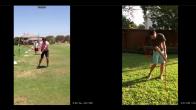
In this example, the golfer has allowed the right leg to completely straighten during the backswing, eliminating the possibility of loading the glutes - the two chunkiest muscles in the body - as they are already near full flexion.
To feel this for yourself, stand up and then do a squat. As long as your knees are flexed, you can continue to actively push down into the ground from your glutes. But, once you straighten your knees, you can no longer push and use the ground for leverage using your powerful glute muscles.
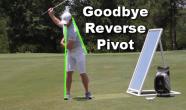
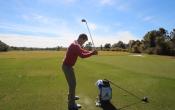
For most amateurs, this leads to the dreaded over the top move that you can see this golfer performing in the second picture. The shaft should be closer to her right arm than her left at this point. She has nothing left to use but her upper body and this creates a lunge at the ball resulting in a very weak shot.
For better golfers, the problem becomes an issue of the club getting stuck behind them as the come down into impact. This happens because instead of straightening the right leg and then not being able to use it, they keep the leg bent and then use the powerful glutes to spin the hips around ahead of the arms and club. This leads to a path that is too far from the inside and creates blocks and hooks. In both cases, maintaining proper knee flex is the key.
If we bring back the original picture of Tiger Woods, we can now start to see where the payoff is when it comes to power. Again, notice the yellow line I've drawn on his belt in the frame on the left. He's in a tremendously powerful position here, his hips bracing as it he actively works to bring his arms back in front of his body.
The glutes are the primary muscles for stabilizing the lower body in the golf swing at impact and are perfectly suited for the job. As he nears impact, notice how much higher his belt is compared to where it was during the transition.
This "squat and jump" appearance is Tiger pushing his ankles into the ground during the transition to "anchor" himself to the ground and actively load the glutes by taking advantage of the SSC.
As he nears impact, his left glute is pushing hard into the ground to move his body away from the clubhead, further accelerrating the club at the very last instant while stabilizing his lower body against the forces of inertia created by the fast moving clubhead. At impact, note that his right knee, while rotated by his hips toward the target, still maintains its flex.
Teaching golfers this sequence can take weeks but is well worth the effort. But, if you don't have an instructor to help you get this much needed sequence down, we can help! Enter the "Anchor"!
The Anchor Training Aid
The Anchor is the one training aid on the market that helps cure all these ailments in the golf swing and does so not as a gimmicky training aid, but from a pure biomechanics perspective.
Developed by Boston Celtics orthopedic surgeon Dr. Brian McKeon, a world-renowned orthopedic surgeon and sports medicine expert, this aid can help dramatically transform your downswing and get you into powerful positions like Tiger Woods you only dreamed of before.
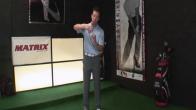
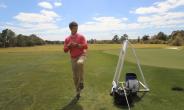
Of course, like any training aid, understanding "HOW" to move and "WHERE" to move from is the key to its success, and in this video we discuss those very things that will make the "Anchor" an important element in your training to become a great golfer.
The Anchor works by locking the knee at a set angle throughout the entire swing. The angle is adjustable by the user for your build and setup position.
Once locked in place, the right knee remains flexed throughout the swing allowing the golfer to actively engage the right glute throughout the swing and not "stand up" during the backswing or downswing. This constant reinforcement works to train the brain through repetition to maintain the flex throughout the swing.
It will not let you straighten up during the backswing and won't let you straighten up during the downswing. Instead, by maintaining your flex, you will be able to feel your right glute activate, perhaps for the first time ever in your swing!
This new, powerful feeling will transform your swing if struggle with any of the problems mentioned above, and best of all, it can be worn while playing! You can quickly unlock the brace and walk to your next shot, then simply engage the tabs and it's ready to go!
You can see the Anchor in action in our video - Maintaining Right Knee Flex.

Ready to add power back into your golf game?
Pick up your Anchor Training Aid today! You can purchase the Perseus Anchor today from Rotary Swing Golf for only $129.

Checkpoints for Practice
- Many golf training aids are gimmicks that have no basis in science or fundamentals
- The Anchor is developed by an orthopedic surgeon & based on biomechanics
- It provides positive reinforcement, keeping your knee in the flexed position throughout the swing
- It helps you feel anchored and braced to the ground
- It helps correct issues like straightening up, feeling unstable on the backswing & over-rotating on the downswing
Video Transcription: Anchor | Create Vertical Down Force
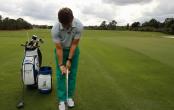
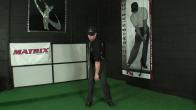
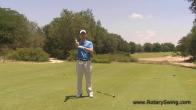
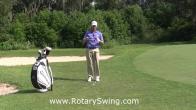
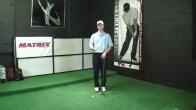
Chuck: It's not very often that I get excited about training aids. So many training aids out there are so gimmicky, and of course we've all seen the "Tin Cup" scenario, where he attached a million devices and his swing is all over the place and he's shanking it and doing all kinds of things.
 The Anchor
Unfortunately, most training aids just lead you down the wrong path. They don't have a lot of basis for what they're trying to do, or why. That's why I've never tried to push or promote any training aids before, because I don't believe in them quite frankly, just because they're not based around sound fundamentals.
That's why this is such a big deal, an exciting deal, to me because the Anchor that we're going to talk about today is actually based on biomechanical principles. Gee, what a novel idea; how about a training aid that's based on science? This is one of the first ones that I've ever seen.
It's great because it's perfect for people learning the Rotary Swing Tour, or any golf swing, for that matter. It's so important for golfers to understand how the body works.
It's challenging at first, because you're learning new movement patterns and you're doing all kinds of things that may be unfamiliar to you if you have dysfunctional patterns. To have something to help accelerate the learning process is great.
The Anchor was actually developed by the Boston Celtics' orthopedic surgeon, Dr. Brian McKeon. He knows a little bit about knees. He's done quite a bit of work with knees, and he developed this product.
He saw so many golfers who struggled with common things in the golf swing; not being anchored and stable in the backswing, or straightening up in the downswing, and all these things. This training aid is hands-down one of the simplest and best ideas out there for helping you do so many right things in the golf swing.
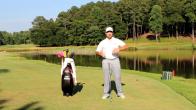
Josh, we know that you've struggled with some things that this training aid helped you with, as well.
Josh: Yeah, absolutely.
I don't have as much trouble going back, although we'll see how that could help people, when they're going back, maintain their knee flex. For me, on the downswing I tend to push really hard with my right side.
 Pushing straightens the leg
Chuck: That's very common. Very common.
Josh: Absolutely.
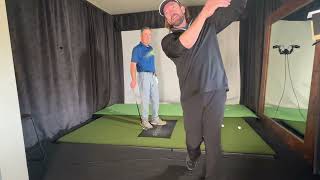
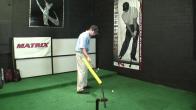
Whenever I would come down, I'd do one of two things when I pushed. I'd either push and raise up and lose my spine angle really badly, and straighten this leg...
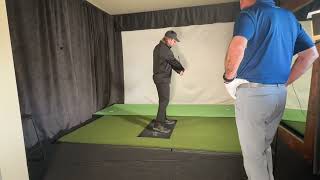
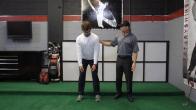
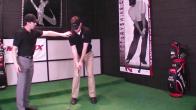
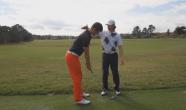
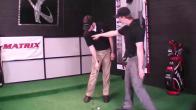
Chuck: Yeah. Why don't you show that from down the line? That's probably 80 percent of the golfers out there. Let me step to the side of you here. We'll see that this move is so common.
Josh: From here, I would just push really hard, straighten the leg, and lose my spine angle.
Chuck: Exactly.
When we do that, all of our angles are changing. Also importantly, your hips rotate more than we need them to during the downswing, right?
Josh: Absolutely. I think as a result of that, too, my arms end up coming in real late and they're way behind my body.
Chuck: Exactly. When we have that happen - when the hips rotate really fast - the arms and hands get stuck back behind the body. They have so much farther to travel to get back down in front. That's probably the most common error we see for better golfers, especially golfers who have really fast hips and are more athletic.
They go really, really hard, and then the arms and hands are stuck and they just bomb it 30 yards right, or hit a big snap hook.
Josh: I've seen that.
[laughter]
 The right leg is straight
Chuck: One of the things that we have to understand with how this aid works is that it prevents that from happening. It gives you positive feedback for what it should feel like to feel stable on the downswing.
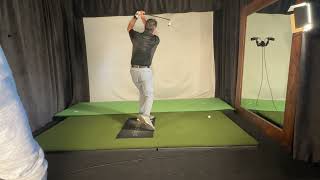
The other common problem, Josh - and you said you didn't really struggle with this much, but we see it all the time in our lessons - is for golfers to straighten up on the backswing. That's typically more of a higher-handicap problem, but show what that would look like.
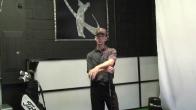
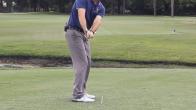
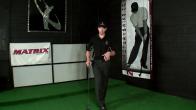
You can see the right leg's fully straightened out. Now Josh can't use his glute anymore. This big muscle in his rear, the chunkiest muscle in his body, is actually fully extended here.
It's just like doing a squat. Once you squat down and you fully extend, you're done. You can no longer push on the ground and use it for leverage. He can't use the ground for stability or leverage to generate any power, so all he can do from here is just use his shoulders and arms that come down from the top.
Eighty percent of high-handicap golfers coming over the top and slicing, a lot of it's due to this. Once that leg is locked out, you can't use your lower body, really anymore, unless you do some sort of compensatory move to try and get the leg to do something, and good luck timing that, right?
It just makes a lot more sense to keep it anchored and engaged the whole time. Why don't we show how this works, Josh?
Josh: OK.
 Using the Anchor
Chuck: All you need to do is get into his address posture. Once he's in his address posture, all he has to do is just flip these tabs - go ahead and flip them down. Yeah, just like that, then do the other one. There's one on each side.
Then just flex the knee a little bit, and try to stand up. At that point, it's locked in there.
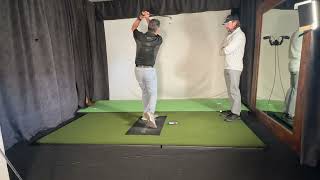
Your knee can't move at this point. If you go ahead and go back to the top of your backswing, it's anchored in. Now, can you feel your right glute activate?
Josh: Oh, absolutely.
Chuck: With his weight on his ankle, he can actively push into the ground. Now he can use the ground for leverage. I know an instructor who used to teach his golfers - maybe he still does - to set up to the golf ball like they're on an ice skating rink; just to feel really light on their feet.
Well, you need to have stability. We're trying to generate a lot of speed and power here, so that's not a real good image.
You want to feel anchored and braced to the ground, and this is what helps you do that. As soon as that knee is straightened up, that glute disengages and you're no longer able to apply any positive - the technical term for it is "vertical ground force" - pushing into the ground, using it for leverage.
Go ahead and go into the downswing. Let's see what would happen there.
[laughter]
 The Anchor preserves knee bend
Chuck: I can see you're trying to move the way that...
Josh: I can try.
Chuck: You're trying to move incorrectly at that point.
Josh is really trying hard to push off that right side, because that's what he knows to do. His leg's not allowed to straighten up, so this is forcing him to stay in that position. We can go back one more step, and let's go into the transition.
As you start to come down, the proper feeling during this first move of the downswing is not to push really hard off that right leg, which is your tendency. Obviously, we know we want to shift our weight by pulling ourselves over with the left, but part of that feeling is getting stable as we're starting to create acceleration in the downswing.
The feeling is going back to neutral, which is where you were at address, so you maintain the knee flex. It's almost like you're doing a little bit of a squat. That's an exaggeration, but what you should feel is that that knee flex stays the same, and that you can continue.
Now you can push both feet into the ground. Now, if you try and straighten your leg up, it's going to change your spine angle, right?
 The Anchor provides positive reinforcement throughout the swing
Josh: Mm-hmm.
Chuck: Of course it's preventing you from doing it, right?
The good thing is that this not only helps you feel and put yourself in the right positions on the way down, but it also helps give positive reinforcement throughout the whole swing. During the backswing we want to make sure that that right leg is remaining flexed and we're pushing that right heel into the ground.
On the downswing we don't want to straighten up and start pushing right away. We want to just anchor ourselves to the ground so that we feel we're pushing both feet into the ground a little bit.
Obviously, we're shifting to the left during that time. Specifically, you need to be very aware of that if you're a higher-handicap golfer, because most higher-handicap golfers don't move enough. They stay back on the right foot and hit a lot of fat and thin shots. If that's you, make sure that you shift, but keep the flex in your right knee.
 Spine angle is maintained
For the better golfers who have a lot of speed like you do, it's really important to feel like you almost sit, to give your arms just a little bit more time to get back in front of your body while you're shifting your weight, and keeping that knee flexed.
How does that feel, if you make a couple of swings and you go into your downswing? How would that feel different to you?
Josh: To me, it feels like I'm covering the ball a little bit now, instead of popping up out of my spine angle, my body being way open and my arms being so late. They're much more on top of the ball, like I'm covering it.
It's a totally different feeling.
Chuck: That's a horrible feeling, especially for a better golfer. When you've got a lot of speed, you just don't know where the ball's going to go after you hit it because of the fact that, as I mentioned, when you start to spin your hips really hard and straighten up early, the arms just don't have time to fall back in front of the body.
It's just not going to happen unless you swung your arms insanely fast. Nobody can really sync that up very well.
What we have to do is get into the position where we almost increase the knee flex. We don't; it stays pretty much the same as it was throughout the whole swing. The brace gives you just a tiny amount of leeway to increase it just a little bit, which you could feel.
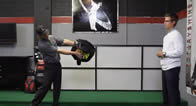
 Chuck demonstrates hip spinning and getting the club stuck
The worst feeling, again, is getting into this position where you've maybe even made a great backswing, an then all of a sudden you're here and you've spun your hips out, you're hurting your back, your club is stuck and you're just going to block or flip it.
This is going to prevent all those things and give you the reinforcement to get yourself into those great positions that all the great golf strikers end up in, especially the powerful ones.
 Just unlatch for full flexion
This simple aid is not only a great way to train yourself when you're on the practice range, but you can also play with it. Josh, you can just flip those unlocked, just push the buttons in, twist it up, and then you have full flexion.
If you're walking or playing in your cart, or what have you, you can play with it during an entire round of golf to continue to get those repetitions. We know how important those repetitions are. Once that's unlocked, you can walk around just like normal. It feels like anything else.
Then show how easy it is to get everything set back up once you're in your posture.
There's four different settings on here. Josh is in the A setting, which is about where most RST golfers are going to be, which is the most minimal amount of knee flex. There's B, C, and D settings as well. You probably wouldn't use most of those.
 Position C
B won't be that uncommon, just depending on your build, but C and D would probably be only used in extreme circumstances where you're on a really awkward lie or something like that. You wouldn't need that much knee flex.
Of course, now we're...
Josh: This is C right here.
Chuck: That's a lot of knee flex on C, so we don't really use those settings. If you're in a situation where the ball's well below your feet or something, you would have to adjust for that, but most RSTers are going to be in the A or B setting.
It's already marked on there for you, so all you need to do is just get into your golf setup, flex your knees, get into the A setting, lock it in, done. You're ready to swing.
You can see, for the first time, this is a training aid that's actually built on principles of biomechanics. Once that leg straightens up you can't use the glutes, you can't use the ground; it's just the way the muscles work in the swing.
Especially if you're used to spinning your hips, this will really help prevent that, to give you the feeling of being anchored - hence the name - that you need at impact.
You don't want to feel like you're spinning out and just hoping to throw the club back out in front of you and timing it at impact. You want to feel anchored and stable, and this is the perfect training aid to help you with that.