Today we're going to tackle one of the most persistent myths in the game when it comes to creating — and once you understand the truth, your entire approach to building power will change.

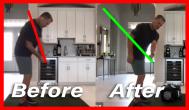
Natural alignment (above) vs. Lag (below)
Many golfers are convinced that golf swing lag is something you manufacture by holding your wrist angle and yanking hard on the downswing, keeping everything locked tight in a desperate attempt to preserve that lag angle through impact.
Is this the fault costing you strokes?
Film one swing on your phone. In about a minute GOATY measures it and names the single biggest thing costing you strokes — free, no card.
Analyze My Swing Free
Related: Golf impact position — how AI scores yours →
Android users: Download GOATY on Google Play — free AI golf coaching on your Android phone. →
Unfortunately, that approach is guaranteed to fail.
Stop reading about it — feel it in your swing today
GOATY watches your swing live and coaches you between every rep. Free. No signup.
Start Your FREE Live Lesson →The natural anatomical alignment of the wrist settles into a slightly forward-cocked position, as shown in the upper photo at right. That's obviously not a position of lag — it's the very thing working against you.
To genuinely build lag in the downswing, you need to keep the wrist exceptionally loose and soft, and simply allow the club to hinge back on its own. The moment you tense up while trying to hold that angle, you contract your wrist flexors and the lag angle evaporates instantly.
One of the most important keys to building lag is maintaining soft, relaxed wrists throughout the entire downswing. The club head is heavy and naturally wants to lag behind — your only job is to get out of its way.
Start Slow & Stack
Now that we understand why tight wrists destroy lag in the golf swing, we need a structured, step-by-step process with focused drills to hardwire the correct feeling into your motion. You can also get a personalized read on your current lag mechanics with a free AI swing analysis that breaks down your specific lag retention patterns.
As always, we're going to begin with very small, deliberate steps and progressively build up to the full 9 to 3 Drill, which is the cornerstone drill for building lag in the golf swing.
Each step introduces a single new focus point. Once you've internalized it, you layer the next piece on top. By the time you work through the entire progression, you'll have accumulated a complete set of checkpoints that you can run through any time you practice your swing.

Keep the wrist very relaxed
You'll use the Swing Viewer to compare yourself side-by-side with Chuck's or Clay's 9 to 3 Drill swings and verify that you're executing each movement correctly.
Step 1 - Mini Swings
We begin with mini swings. If you have access to a swing donut or a weight ring, attach it to your club before starting.
You can absolutely run through the drill without it if one isn't available, but the added weight does a tremendous job of amplifying the sensation of inertia created by a heavy club head — and feeling that inertia is the foundation of understanding how to create lag in the golf swing.
Start making short swings with your trail hand only. Swing back roughly a foot and through a foot. Keep your trail wrist and forearm completely loose and relaxed, allowing the club to flow freely back and forth in these small, unhurried motions.
Don't pull your arm back into a big backswing. Don't try to generate any power. At this stage, it isn't really a golf swing at all — you're simply keeping your wrists soft and feeling the weight of the club head naturally pulling back and forth.
Once you've done that for a bit and feel comfortable with the sensation, switch to the lead hand only. Perform those same small swings, again with the lead wrist loose and relaxed throughout.
Step 2 -
The next step is to introduce some weight transfer as you continue allowing the club to swing back and forth freely.

Hips move toward the ball
You want roughly 60-70%, perhaps even 80% of your weight to shift to the inside of your trail foot.
Don't sway all the way to the outside of that foot. Stay loaded on the inside of the trail foot, exactly as you would during a full golf swing.
In a real golf swing, the weight shift back toward the lead side begins just before the club completes the backswing. In this drill, you want the same timing — start transitioning your weight lead-side while the club is still traveling back.
As you shift that weight forward, the critical key is to make sure your weight moves to the center of your lead ankle.
If you allow your weight to drift onto your lead toes, your hips will push toward the ball and you lose the room needed to swing the club freely through impact. This is one of the most common mistakes we see. Make certain the weight stays centered over the lead ankle — not forward onto the toes.
Keep the swings small and effortless. Spend a minute or two building this feel, while making sure your lead wrist remains soft and unhurried throughout each repetition.
Step 3 - Flat Trail Wrist

Wrist flat in the backswing
Now that you've developed the sensation of the weighted club head lagging naturally behind your hands with loose, supple wrists, it's time to work through the same motion without the swing donut. Start again with the trail hand only.
Remove the weight and perform that small swing. Continue applying everything you've built so far, and now layer in one additional focus: keep your trail wrist flat throughout the backswing.
Many golfers attempt to manufacture a lot of artificial wrist cock and lag in the backswing, then fight desperately to hold onto it on the way down. That is exactly the destructive habit we're dismantling with this progression.
When you fully hinge and cock the wrist at the top of the backswing, you essentially pre-spend your lag — and the moment you start the downswing, you start losing it immediately.

Losing lag in the downswing
Instead, keep the trail wrist flat and relaxed as you swing back. As you transfer your weight lead-side, the momentum of the club head keeps moving back on its own, so when your hand begins moving forward again the club head will naturally lag behind — without any conscious effort to hold it there.
True lag isn't built in the backswing. You build lag in the downswing at the moment of direction change — that's the instant the club head literally lags behind the hands due to its own inertia.
Make 50-60 repetitions of these small trail-hand swings and really concentrate on the feeling of lag forming not at the top, but at the transition as weight moves forward and the arm changes direction.
After several minutes of trail-hand swings, once you feel that you're doing them well, return to the same drill using only the lead hand.
Stop and Check
Now is the time to pause and evaluate your form. All of these drills are available in the Swing Viewer. Set your swing side-by-side with Clay's and verify that you're executing the movements correctly:
- Look at your hands in the backswing. Is your trail wrist staying flat and straight throughout the swing? If you already have 30-40 degrees of wrist hinge in the backswing, you are performing the drill incorrectly.
- On the downswing, if Clay's club is still elevated and yours is already approaching impact, your wrists need to be noticeably softer and more passive.
If everything is matching up well, you're ready to progress to the next set of drills.
Step 4 - Lengthen the Swing
The next step is to gradually extend the length of your swing.
Begin again with the trail arm only and expand the swing out to the full 9 to 3 Drill range. The trail hand should reach approximately waist height — or just slightly above — in the backswing.

Swing to about waist high
Make a few swings, keeping all of the same checkpoints active that you've been building throughout this progression. It's critical to keep your wrists loose — don't allow them to tighten as the swing gets longer. That tension is the enemy of lag mechanics.
This is the stage where many golfers begin to flip the club at impact in an attempt to release it, but that is precisely what we are working to eliminate.
As you swing down, clubhead speed and lag are created naturally by allowing the club to flow. The weight of the club head releases itself through centrifugal force — no manipulation required.
You are not pushing with the trail hand. In fact, you're not taking any deliberate action to head at all. You're simply allowing it to release under its own momentum and weight.

The club is vertical in front of the left leg
If you execute this correctly, the club shaft should be pointing straight up and down as it comes into line with the front of your lead thigh.
If it reaches vertical before it even gets to the trail thigh, that means the trail wrist is getting active — you're pushing with the trail hand and flipping the club instead of letting inertia do the work.
Your two checkpoints at this stage: make sure you aren't swinging the arm too far back and manufacturing artificial lag with a pre-cocked wrist, and make sure you are not flipping with the trail hand as the club approaches the bottom of the arc.
Now the Lead Side
Once you're comfortable performing the drill with the trail arm only, repeat the same motion using the lead arm alone. Again, use the 9 to 3 backswing position — approximately waist high. On the downswing, apply all of the same checkpoints you dialed in with the trail arm.

The club is still parallel to the ground
The club should still be parallel to the ground when your lead wrist comes down in front of your trail thigh. Freeze-frame your video and check — it should closely resemble the photo at right.
This checkpoint is equally valuable when you eventually work up to full swings. Freeze your video when the lead wrist is at the trail thigh and verify the lag angle is intact.
Common Pitfall
Now that you're training the lead arm, you need to ensure your chest is not spinning into an open position as you swing through impact.
A large percentage of golfers who struggle to retain lag are aggressively spinning their chest open in an attempt to generate power. It can feel extremely powerful — but that chest rotation is one of the fastest ways to destroy golf swing lag. Spinning the torso causes everything attached to the body to move outward and away, throwing the club head away from the hands and eliminating any angle you had stored.

The chest still points at the ball
If you haven't seen it yet, watch the "Key to Creating Lag" video. It explains in detail how opening the torso too early spins the spine and causes the club head to fly away, killing lag. The GOAT Drill system addresses this rotation problem directly — you can explore the full approach in the GOAT Drill video lesson.
The key takeaway for this stage of the drill is straightforward: keep your chest pointing toward the ball as you swing through impact.
Even as the hand travels all the way to the finish, your chest should still face down toward the ball at that moment of follow-through.
Make a few more swings with that chest position locked in, and then you'll be ready to put both hands on the club and perform the full 9 to 3 Drill.
Finally, the Full 9 to 3 Drill
There are a few final checkpoints to keep in mind as you step into the full two-handed 9 to 3 Drill:
Many golfers attempt to preserve wrist hinge and lag by cupping the lead wrist, but that's not a solution — it's a trade-off that costs you significantly at impact.
When you cup the lead wrist, you're adding loft to the club face. You may succeed in retaining a lot of lag angle, but you're arriving at impact with a wide-open face, and that is obviously the opposite of what you're after.
Others develop the habit of keeping the trail arm heavily bent and leaning back onto the trail side because it feels like they're storing tremendous lag.
You'll find instructors on video platforms recommending this position as a lag solution, but as you can see in the photo at right, it's nowhere near the efficient impact position you're working toward.

Right arm bent - the wrong way to get lag!
Keeping the trail arm tucked back forces the club to travel too far from the inside, leaves weight stacked on the trail foot at impact, and requires a flip move to get the face through the ball correctly. It creates a cascade of compensations that are extraordinarily difficult to manage consistently.
The correct approach is to extend the trail arm and get the shoulders much more level through the impact zone (see the "Level Shoulders Drill" video), then allow the club to work down toward the ball just as you practiced in the Throw the Ball Drill.
Keep the trail wrist loose and passive. If it tightens up as you attempt the Throw the Ball movement, you'll cast the club and immediately lose all of your stored clubhead speed and lag angle. But as long as the wrist remains soft and relaxed, you can drive through that motion with full intention and still build and retain lag in the downswing.
Put It All Together and Review
At this stage, go back and run through every piece of the progression to confirm that all the elements are present in your full 9 to 3 Drill swing: weight transfer, free-flowing hands, a flat lead wrist through impact, and a soft trail wrist that never grips the release. Stack all the checkpoints together and make sure they are all showing up simultaneously.
Once again, use the Swing Viewer to compare your drill against Clay's or Chuck's 9 to 3 Drill. The frame-by-frame option is an invaluable tool for isolating key moments and verifying that each piece of your lag mechanics is executing as intended. You can also track real progress in your golf swing lag over time with a free AI swing analysis that scores your mechanics and shows exactly where your lag is being lost.
Watch part 2 now to see how you're moving your body in the opposite direction of the pros!


















































































































































































 Left wrist is flat (above) not cupped (below)