Lag is widely regarded as the holy grail of the golf swing. Legendary ball strikers like and Sergio Garcia maintained extraordinary amounts of golf swing lag, allowing them to generate tremendous clubhead speed and hit the ball remarkable distances with what appeared to be minimal effort.
For the typical amateur golfer, lag in golf feels like a closely guarded secret that only naturally gifted players and elite ball strikers can access. Many believe you either have it or you don't.
Want to feel this in YOUR swing? Try a free AI-powered golf lesson → — GOATY gives you real-time voice coaching, pose tracking, and instant feedback on every rep.
Related: Golf impact position — how AI scores yours →
Android users: Download GOATY on Google Play — free AI golf coaching on your Android phone. →
As a golf instructor who is dedicated to teaching the real physics and biomechanics behind the swing, I can assure you that there is nothing mysterious about lag at all. In reality, creating and maintaining lag is something any golfer can learn when they understand the correct mechanics. It's actually quite straightforward once you know the right approach.
Stop reading about it — feel it in your swing today
GOATY watches your swing live and coaches you between every rep. Free. No signup.
Start Your FREE Live Lesson →
"Been playing for 15 years and a number of lessons and never heard a better description of why and how losing and maintaing lag happen. I'm excited to go and drill this out. [I] don't expect miracles, but at least there is hope and a vision to getting better. Aloha and Thx"
-Tony P. | July 20, 2012 | Hawaii

18° more lag in only 10 minutes of working on the drill in this video!
In this detailed 18-minute video, I'm going to walk you through how I worked with one student and helped him achieve 18 degrees more lag in his downswing in less than ten minutes. The transformation was dramatic and immediate.
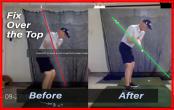
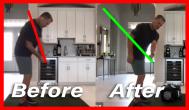
In the first image on the left, you can see where this golfer was before we started working on my lag drill. On the right, you can see the results after just 10 minutes of focused practice using the exact drill you're about to learn in this video.
Look at the amazing amount of lag he has preserved at the identical point in the downswing. There is roughly 18 degrees more wrist hinge retention in the image on the right, and his sternum is covering the ball much more effectively, a hallmark of proper impact position.
"The last week, I started on the downswing section and watched this video 5 times and realized what I was doing wrong. I went to the range today for the first time since starting the downswing section, and I never hit the ball better in all the years I have been playing. I finally felt what it was like to compress a golf ball!!! I easily gained 10-15 yards with each club, and my consistency in accuracy and taking a divot were unbelievable. I think today was the first time I have ever felt what a relaxed and athletic golf swing feels like."
-Paul M. | Aug 21,2012 | Hampton, VA
Below, you can see a direct side-by-side comparison of club positions at the same moment in the downswing. Notice that when the shaft reaches parallel to the ground, the butt end of his club on the left is actually positioned behind the ball, a clear sign of lost lag in golf.

Notice how the butt of the club is now ahead of the ball when the club is in the same position.
After practicing the drill, the butt of the club is well in front of the ball, and the angle between his trail forearm and the club shaft is still significantly greater, even though his hands have traveled further forward. This is exactly what proper golf swing lag looks like in action.
For a striking comparison, I pulled in a frame of Hank Kuehne at a roughly similar point in the downswing, though the positions aren't perfectly identical. You can see just how much lag my student added in only 10 minutes, rivaling one of the longest hitters in PGA Tour history!

This golfer now has even more lag than big hitting pro Hank Kuehne!
Are you starting to see how achievable this power really is? If you want to measure your own lag and downswing mechanics objectively, try a free AI swing analysis to see exactly where you stand.

On the right, he's now got a near-perfect impact position, with his hands ahead of the ball.
Now for the big payoff. Take a careful look at the dramatic difference at impact.
In the before image on the left, notice how the clubhead has already overtaken his hands, a classic sign of an early release. In the image on the right, he still has his hands positioned in front of the ball at impact, achieving forward shaft lean. This is a position that every amateur golfer dreams about achieving, and it's a position you're going to learn how to create in this video!
Are you ready to develop more lag in your golf swing and unlock genuine power?
"I'm now getting tremendous lag and have substantially added distance to all shots. As much as 30 yards with my driver."
-Jim S. | Sept. 11, 2012 | Evanston, IL
Watch the full video to dramatically increase your lag right now, in less than 10 minutes! Then put your results to the test with a free AI golf lesson to track your improvement in real time.
Video Transcription: in the Downswing Secret

Before the lesson
We're going to do a two-part video series here on golf swing lag. The first part covers what you see on screen right now, where I break down a real golf student's transformation. The second part is a hands-on demonstration of the exact swing drills I used with this student to produce these ideal positions and dramatically increase his lag in golf.
This particular student flew over from Ireland to work with me for a couple of days. He was actively pursuing a professional career, so he took his golf swing extremely seriously, just like you do.
He came in with a couple of really common faults that countless golfers struggle with, and these issues were leading to inconsistent ball flight. His swing path was tracking too far from the inside, producing a very high ball flight with a tendency to either block it high right or hit a high draw.
Neither of those shot shapes is viable at a professional level. We needed to develop a much more penetrating ball flight and get the path straightened out for reliable shot shaping.

After 10 minutes of instruction
The long and short of it was that a significant portion of these problems traced back to the amount of golf swing lag he was losing on the way down. Of course, lag is this big, elusive concept for the average amateur golfer. Most players assume there's simply no way to develop it, that you either have it naturally or you don't, or they've resigned themselves to never achieving it.
That's simply not true. Golf swing lag is a natural byproduct of executing a few key movements correctly. In the drill portion of this video, I'm going to show you precisely how to produce it and demonstrate exactly how I achieved the results you see here in under 10 minutes of practice.
With Greg here, the image on the left is his very first swing that I filmed, with zero coaching input from me. It was simply his first swing of the day after he had already warmed up. The image on the right shows him after just 10 minutes of working specifically on lag.

Before - Hands behind the ball
You can immediately see a dramatic difference. To illustrate this with a couple of simple reference lines, we can draw a line from the butt end of the club in each frame. I'll try to get both of these as accurate as possible.
With the first swing, there's the butt of the club. He chokes up on it slightly. And there's the butt of the club in the second swing.
At the point where the shaft is parallel to the ground, and these frames are perhaps a half-frame off but as close as we could match, notice that his hands and the butt of the club are actually in front of the ball when the shaft is parallel to the ground in the improved swing. In the original, the butt end is well behind the ball, indicating a significant loss of lag in golf.
You can also observe a couple of other telling differences. In the improved swing, the butt of the club is now positioned in front of his head. In the original, it's sitting roughly underneath his lead eye.

After - Hands in front of the ball
The most important thing to notice is that you can see a portion of his trail thigh here in the improved version. Part of our specific goal with the drill I'm going to teach you was getting the hands back in front of the trail thigh when the shaft reaches parallel to the ground. The key is the golf swing lag drill that I'm going to walk you through step by step.
These are the critical checkpoints you need to monitor when learning how to create lag in a golf swing.
When you start examining angles, you'll notice that in the improved swing the angle between his trail forearm and the club shaft is greater than 90 degrees. In the original, it's approximately 90 degrees at a point where the hands are further along. He's maintained considerably more lag throughout the downswing, and that additional angle translates directly into stored power.
As we advance a couple more frames in each sequence, additional differences become apparent.

Hands and chest before the lesson (right) and after 10 minutes of instruction (right)
Notice now that his hands, two more frames further, are much more in front of the ball in the improved swing. He's going to deliver a much more descending blow at impact. Observe that the position of his hands is also much more in front of his chest, indicating better sequencing.
If I remove the reference line from both frames, it becomes very easy to see that in the improved swing his hands are positioned right here, back in the center of his chest. In the original, they're well behind. The reference line actually points in the opposite direction. It's slightly off there, but the concept is unmistakable.
What the original position causes is an early release of the club, which destroys clubhead speed and power. To compensate for this lost lag, he had to work extremely hard to turn his body and hit aggressively with his torso, an approach that creates inconsistency.

A little too much shaft lean
You can see exactly how much the muscles in his lead arm are strained and tense in the original, whereas in the improved swing they're essentially relaxed. That relaxation is another critical piece you'll understand as we get into the drill portion.
Now, in the process of learning this new movement pattern, he naturally tends to overdo a couple of things. We're going to see that at impact, where he has his hands pushed a bit too far forward. But that's a far better problem to have than casting the club early.
Notice again that in the improved swing he still maintains a significant angle between that trail arm and the shaft. In the original, he's losing that angle rapidly. Just before impact, he has really shed a lot of angle. We do want to release the club at some point, but notice how in the improved version he arrives at impact with substantial forward shaft lean.
Again, there's a point where you can have too much golf swing lag at impact. He has slightly overcooked it here, and that's something we'll refine. But in the same frame on the left, the clubhead has actually passed his hands already, meaning all stored power has been spent too early. In the improved version, he's actually driving through the ball, compressing it properly with excellent forward shaft lean.
Technically, we would work on dialing back just a touch of that shaft lean, but we're extremely close to an absolutely ideal position. It's a massive transformation between these two impact positions, these two release positions, and most importantly in the resulting ball flight.

Before the lesson (above) and after (below)
The ball flight difference tells the whole story. You can see the ball launching very high in the original. In the improved swing, the ball comes out with a much more penetrating trajectory, which was exactly the outcome these shots produced. You must learn how to create lag in a golf swing if you want that low, boring, penetrating ball flight that holds up in the wind.
Advancing one more frame on each side, the ball on the original side is climbing much higher, while in the improved version he still has his hands ahead of the clubhead.
Obviously at some point we want the club to fully release, but we're working on one fundamental at a time. The central focus here was maintaining lag. Lag is the key to the golf swing. It is the key to effortless power, and it is, believe it or not, the key to consistency as well.

Great form - this could be you
Most golfers don't realize the connection between lag and consistency, but as we get into the drill that I'm going to demonstrate in the second half of this video, you're going to see exactly how you can create these same positions in your own golf swing.
No matter what your handicap is, you can achieve this incredibly powerful position where the hands are back in front of the body, you've maintained a tremendous amount of lag between the trail forearm and the shaft, and the hands are leading. You can absolutely start hitting penetrating golf shots like you've never experienced before. I'm going to break all of that down for you in this next section of the video.
By now, we've watched the first half of the video showing a student who made a remarkable improvement in the amount of lag he retained during the downswing. I promised you I was going to provide a drill to show you how to achieve the exact same transformation.
First, before we jump into the drill itself, I want to clearly define what lag actually is so that everyone is on the same page and understands what we're working with. Second, I'm going to show you the incorrect movements that destroy lag. And third, I'll walk you through the specific drill to show you how to create and maintain it.

90° angle with the left arm - This is NOT lag
Let's start with the most fundamental piece: making sure we all share the same definition of lag in golf, because there are a lot of misconceptions circulating about what it actually is in the golf swing.
Most people, including many golf instruction professionals, will define lag as the angle between the lead forearm and the club shaft during the downswing. Right now I have roughly a 90-degree angle here, and that would be considered, depending on the point in the downswing, as having significant lag.
The problem with that definition is that the lead arm angle has nothing to do with true power storage. It doesn't matter what the angle between the lead forearm and the shaft is, because that angle needs to get released during the downswing as part of the natural process that squares the club face.
What we actually need to measure is the angle between the trail forearm and the club shaft. That is what golf swing lag truly represents. It's this specific angle that determines how much power you can deliver at impact relative to the effort you're exerting throughout the swing.

Lag is created with the right arm
It's that classic question of "powerful effort or effortless power," and which one defines your golf swing. We want that effortless power feeling, and the vast majority of that sensation comes from conserving this wrist hinge angle, this lag, deep into the downswing so that we arrive at impact with stored energy.
What constitutes a good angle? A straightforward checkpoint that I consistently use with my students is this: when the hands start to get back in front of the trail thigh, roughly in front of the pocket, I want to see the club shaft parallel to the ground.
In other words, you can see here that my club shaft is parallel to the ground, my hands are back in front of my trail thigh, and I can see just the slight edge of my trail thigh visible on the outside of my arm. That's the position we're targeting.

The opposite of lag
The opposite of that ideal checkpoint would look like this. Now I've lost all my lag. This is the position where most amateurs find themselves during the downswing, or you could go even more extreme and retain an excessive amount of angle. We don't need that extreme; too much lag is going to require an abnormally strong grip to square the face.
The club is parallel to the ground, hands are positioned back in front of the thigh, and you can just barely see the outside of your trail thigh. In a full downswing motion, the sequence would look approximately like this.
Anything beyond this checkpoint, and you're going to start running into problems where the club face arrives open at impact, or your hands are pushed too far forward, de-lofting the club face excessively, and creating a whole cascade of compensations. There are significant issues with overdoing it.

The wrong way to create lag
This checkpoint position is the sweet spot, and if you achieved it consistently, for 99 percent of amateur golfers it would completely transform your game and your ball striking.
So now we know what lag is. We know what it needs to look like at the critical checkpoint. Now we need to understand, first, what do most golfers do incorrectly that causes them to lose it? That's the essential question. The number one mistake most golfers make is reaching the top of the backswing and unwinding their shoulders as aggressively as possible.
That is the single worst thing you can do for conserving lag in the golf swing, and here's the biomechanical reason why. When you reach the top and immediately start spinning your shoulders open, you're generating centripetal force. You're creating a rotational force that acts directly on the golf club.

The club is thrown outward
The part of the system farthest away from the center of rotation, the clubhead, is going to want to fly outward when you start rotating. It's a simple cause-and-effect relationship, basic Physics 101 applied to the golf swing.
Think of a child on a merry-go-round. If you're standing at the center of the merry-go-round and it's spinning very fast, what happens to kids sitting on the outer edge? They want to get flung off. The centripetal force pushes them outward.
You are the center of that merry-go-round. When your upper body starts spinning fast from the top, the clubhead wants to get flung away from you. That's why most golfers, among several contributing factors, lose a tremendous amount of lag. They reach the top and do this aggressive rotation, and the forces they've created make it nearly impossible to maintain any meaningful angle between the trail arm and the shaft.
That's the first critical key. What we want to feel instead is that the lead shoulder stays shut, stays closed to the target, as we begin bringing the club down into the downswing.

Drill to maintain lag
This brings us to the drill itself. This is exactly how we maintain that lag. If our shoulders are staying shut and quiet, how does the club get down to the ball? This is the fundamental key in learning how to create lag in a golf swing.
As we go back to the top and start the downswing, shifting into the lead side, we're pulling the club down with what, for most of you, is going to feel like exclusively the trail arm. That's how we arrive at this checkpoint position. All I'm doing is this: pulling my club down with the trail arm while simultaneously shifting my weight back into my lead side, bringing the club to that ideal position.
Now I place both hands on the club, now I have lag, I drive through impact, and then release.

The left shoulder is lower than the right
It's not about spinning your shoulders, spinning your hips, or any of those aggressive body-driven movements. Those rotational forces are going to alter your secondary , change the angle of your shoulders, and destroy your stored power.
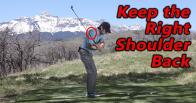
Here are some straightforward checkpoints to make sure you're executing this correctly. As we start the downswing, we want to feel that the lead shoulder, as I described, stays shut. But a second critical feeling is for that lead shoulder to feel as though it's always lower than the trail shoulder.
What I mean by that is you can see that the imaginary shaft across my shoulders is angled such that my lead shoulder sits lower than my trail shoulder. The opposite, having the lead shoulder higher, would look like this.
What we want to feel is that as we come down through the downswing, the lead shoulder stays low and what we would describe as "in the shot" as you continue to bring the club down with your arms toward the impact position.

Avoid this!
What you don't want to feel is this position, where I have excessive secondary axis tilt, the lead shoulder is very high, which will cause me to lose lag and produce all sorts of swing path and plane issues as a result.
The first feeling is shoulders shut. The second feeling is the lead shoulder staying below the trail shoulder all the way into impact. It won't actually be lower the entire time, but it needs to feel that way for most golfers. Lead shoulder low, continue to bring the trail arm down to that checkpoint we established, where I've still got a full 90-degree angle between my trail forearm and the shaft, and my hands are positioned just about in front of my trail thigh.
All we're doing to achieve that, again, is taking the trail arm, forgetting about everything else, and pulling it straight down. This is the entire movement. Top of the backswing, pulling the trail arm down.
This is the simplest pathway for you to start feeling what a proper golf swing sequence actually feels like. Most golfers are excessively lead-side dominant in their downswing. That dominance is what drives the spinning motion, pulling the lead shoulder up, yanking the lead arm down prematurely. That's precisely why they lose lag.
You're going to start practicing with the trail arm only, developing the feeling of pulling the club straight down. What this accomplishes is that instead of generating all that destructive centripetal force through spinning, we're creating vertical movement. It's going to feel as though your trail arm is moving straight down toward the ground.

Bring the shaft straight down (exaggerated)
Let's examine this from down the line, because that perspective reveals another key piece for golfers who are accustomed to spinning their shoulders and getting the club trapped behind them. They're used to approaching from way inside with a very shallow club path, and then they learn to time a flip at the bottom. This pattern creates either a block or a hook, as you're probably well aware.
What we want to feel in the downswing is that the shaft is coming down, and I'm going to exaggerate this slightly for the camera, nearly vertically. It's not actually vertical. So when I combine both elements, you're going to see that as I start pulling just my trail arm down, the club isn't excessively steep at all. It's coming down exactly on plane, tracking right where it should be, and into impact.
When you practice this yourself, what you're going to experience is the sensation that the shaft is driving straight down into the ground. I've just demonstrated on camera that it isn't actually doing that, but even for me, after performing this drill thousands of times, it still feels like the shaft is coming straight down vertically.
It should feel very steep, especially if you're accustomed to pulling out with that lead shoulder, aggressively spinning the hips, and consistently getting the club stuck coming from the inside. This Trail Arm Down Drill is going to feel like the club shaft is descending almost vertically, and that's the correct sensation.

Wrist rotation
That's the first component. The second key, when you're viewing from down the line, is that if you executed everything else perfectly and started the downswing with this trail arm drill, pulling your arm straight down, the club face is going to arrive looking slightly open.
The natural tendency would be to come through with an open club face and have to time a last-second flip to square it. Obviously that defeats the purpose, so there's one final piece to this Trail Arm Only Drill, and that's a small amount of forearm rotation in this direction.
You can see how my trail hand is working through this motion. Watch what happens to the clubhead as I incorporate this rotation. I'm going to the top, closed hip slide, sitting into my lead side, keeping the shoulders shut, lead shoulder low, feeling like I'm pulling my trail arm straight down.
It feels like the club shaft is tracking very steeply, and now I'm just going to rotate my forearm a tiny amount. Let me demonstrate the stuck position first. This would be trapped and open. Now I'm going to rotate my forearm just slightly.

Club open (above) & with forearm rotation (below)
Notice that as I do that, it pulls the club from being stuck and behind my hands to being aligned with my hands, bringing the club back out in front, and now I can release naturally. This subtle amount of rotation is going to be the final key to help start squaring the club face early in the downswing.
You don't want the club face sitting wide open and then try to time a desperate flip at the last possible moment. We want the face to be squaring progressively, so now you can see it's starting to look at the ball, continuing to look at the ball, now it's square, and then releasing fully without requiring a tremendous amount of timing and effort to achieve solid impact.
Those are the essential keys to learning how to create and maintain lag in the golf swing: quieting down all of the excessive body rotation because most golfers dramatically overdo it.
Not every golfer has this problem. Many golfers who first learn to engage their body correctly go too far with it. But because the majority of our members are more experienced golfers, we target the tendencies they typically exhibit, which is overusing the body at the expense of arm mechanics.
You're going to feel virtually no body rotation, pulling your arms straight down, the trail elbow returning in front of the body. You can see it's back in front of my hip, the trail arm rotating slightly. You can see a bit of my trail thigh here, and then the full release of the club through impact.

Creating lag correctly
That's the complete key to creating golf swing lag. Start working on the Trail Arm Only Drills: trail arm pulling straight down, the shaft feeling like it's descending vertically. See if you don't dramatically improve your lag and clubhead speed. Post your before-and-after pictures and videos on the forum, and try a free AI swing analysis to measure exactly how much lag you've gained!
Watch part 2 now to see how you're moving your body in the opposite direction of the pros!