Today we're examining one of the most underrated fundamentals in golf — the role of the forearms in putting. This concept rarely gets discussed, but proper forearm alignment is quite possibly the single most important setup element for consistent putting.

Chuck's putting grip
There are two keys to setting up correctly with the putter. The first, which we can observe in this photo of Rotary Swing Instructor Chuck Quinton, is the grip.
Is this the fault costing you strokes?
Film one swing on your phone. In about a minute GOATY measures it and names the single biggest thing costing you strokes — free, no card.
Analyze My Swing Free
Related: Golf swing lag — why AI coaching fixes it faster →
Android users: Download GOATY on Google Play — free AI golf coaching on your Android phone. →
Notice that his hands appear to sit almost underneath the putter, meaning that the "V" shapes formed by the thumb and forefinger on each hand point away from each other rather than toward the same shoulder.
Stop reading about it — feel it in your swing today
GOATY watches your swing live and coaches you between every rep. Free. No signup.
Start Your FREE Live Lesson →Let's zoom in for a closer look. Drawing lines along the V of each hand, you can see they point back at their respective shoulders.

Close up
Drawing a line down the middle of the shaft, the hands and shaft form a perfect Y shape when viewed from face on.
This alignment matters — not primarily because of what you see face on, but because of what it creates in the down-the-line view, which we'll examine shortly.
The importance of this grip is that it takes your hands out of the putting stroke, allowing you to rock back and through with your body for dramatically greater consistency.
Taking The Hands Out

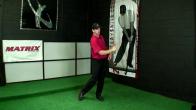
As Chuck swings back and through, his hands remain extremely quiet. There's zero breakdown throughout the stroke.

After impact
The hands are a critical component of becoming a consistently good putter. You absolutely cannot afford flinchy or twitchy hands through impact. They need to remain completely passive.
The only reliable way to prevent the yips and avoid flipping with the trail hand is to grip the club so that — when viewed from down the line — the shaft sits in perfect alignment with both forearms, as shown below.
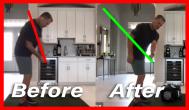
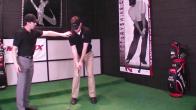
From the down-the-line perspective, the shaft and both forearms form one perfectly straight, unbroken line extending right up through the elbows. This alignment is critical.
Taking a grip where the V of each thumb points back at its respective shoulder is what makes this straight-line alignment possible.
Simpler and More Consistent
In a regular golf swing, both V's point toward the trail shoulder — but you don't want that in putting.

Shaft aligns with forearms
The reason comes back to forearm alignment and, ultimately, removing the hands from the stroke. Getting the forearms aligned with the shaft allows you to control the putter with your body and shoulders rather than your hands and wrists.
On a longer putt, you'll naturally have a tiny amount of hand movement and some arm movement independent of the body. But the simpler you make the stroke, the more consistent and repeatable it becomes.
Watching Chuck putt, you can observe that the forearms and shaft maintain their alignment all the way back and through the stroke.
If you were to place your thumbs straight down the shaft — as in a normal — the shaft would sit lower than the forearms, as illustrated by the blue line in the photo.
That's the alignment you want for a full golf swing — and precisely why it's wrong for putting. That grip puts the trail hand in a dominant position.

Shaft would not align with forearms if thumbs were down the shaft
When your thumbs ride down the shaft rather than to the sides, the trail hand sits in a dominant, active position. The trail wrist can release freely, and the lead wrist will simply allow it to happen — producing pulled putts and inconsistent face control.
Moving your hands to the sides of the shaft makes it natural to align the forearms correctly. Your hands will stay completely quiet, and you can simply rock back and through with your shoulders.
This is an exceptionally reliable, consistent way to putt.
When adjusting your grip, pay close attention to the face-on view. Verify that the V of each thumb points back at its corresponding shoulder.
Once you've established a proper grip, make a normal putting stroke. You'll immediately notice that the putter blade doesn't wander. It stays remarkably square because the forearms and shaft are working in alignment — creating a simple, stable stroke.
Adjusting your grip will feel unfamiliar at first, particularly if you're accustomed to using a lot of trail hand activity in your putting.
Your trail hand may be used to sitting on top of the shaft with the thumb running straight down. That's a finicky way to putt because the hands can easily become overactive during the stroke.

The shaft stays aligned with the forearms all the way back and through
Try this grip, get the shaft aligned with your forearms, and you'll start seeing much more consistency in your putting. For the same kind of precision analysis on your full swing, try a free AI swing analysis that breaks down your mechanics in detail. To practice with real-time coaching, check out a free AI golf lesson.
Watch part 2 now to see how you're moving your body in the opposite direction of the pros!